
Ritual Performance, the Six Houses, the South Temple, and the Ossuary
A reconstruction integrating architecture, reliefs, performance technology, the Great Ball Court Stone, The Ossuary, and the Popol Vuh – By Donna Evans
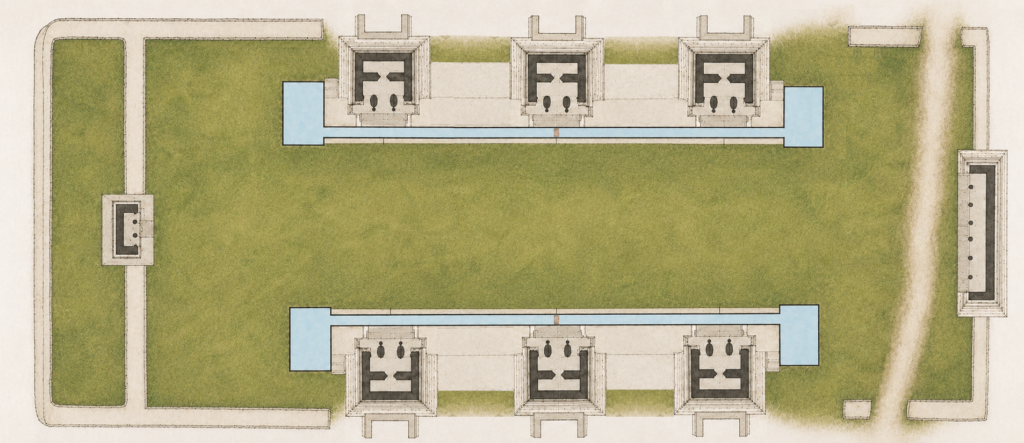
Abstract
The Great Ball Court at Chichén Itzá was not merely an oversized sporting venue. Its architecture, reliefs, wall-top buildings, water system, celestial alignments, South Temple carvings, Great Ball Court Stone, and associated ritual equipment form a coordinated architectural reenactment of the Hunahpu/Xibalba narrative.
The six buildings positioned above the court correspond to the six Houses of Xibalba: Dark House, Flint House, Cold House, Jaguar House, Fire House, and Bat House. These were full-sized ritual structures occupied overnight by priests or performers, allowing the Heroes to emerge at daybreak as they do in the narrative. After the sixth night, the performance shifted to the court itself for the events associated with Hunahpu’s replacement head, the final ballgame, death and resurrection, and their disguised return.
The South Temple preserves the same six-part sequence in its six carved pillars. The Ossuary preserves the preceding first generation narrative of One Hunahpu and Seven Hunahpu. Its sanctuary imagery, ballgame symbolism, seven exceptional shaft graves, altar objects, central carved pillars, and descending pictorial sequence connect the deaths of the first generation of ballplayers with Xibalba itself.
Together, these monuments preserve different portions of a single narrative landscape in which mythology was not merely illustrated on buildings. It was physically enacted through them.
1 Scope and Method
This analysis combines evidence that is usually considered separately: surviving architecture, Alfred Maudslay’s nineteenth-century documentation, excavation reports, modern archaeological reconstruction, solar observations, Great Ball Court reliefs, the Great Ball Court Stone, South Temple sculpture, the Ossuary, and the narrative preserved in the Popol Vuh.
The central method is cross-correlation. Architectural features are compared with narrative requirements, imagery is examined in its physical sequence rather than as isolated motifs, and repeated visual elements are tracked between monuments.
The resulting identification does not depend upon a single jaguar, bat, serpent, ball, or decapitation image. The evidence occurs in ordered sequences. Architectural positions, repeated numbers, identifiable trial imagery, narrative transitions, ritual objects, and physical features repeatedly occur where the corresponding events require them.
The identification of the Hunahpu/Xibalba narrative is therefore presented here as the functional explanation of the complex and Chichen Itza in general.
2 The Court as More Than a Sports Venue
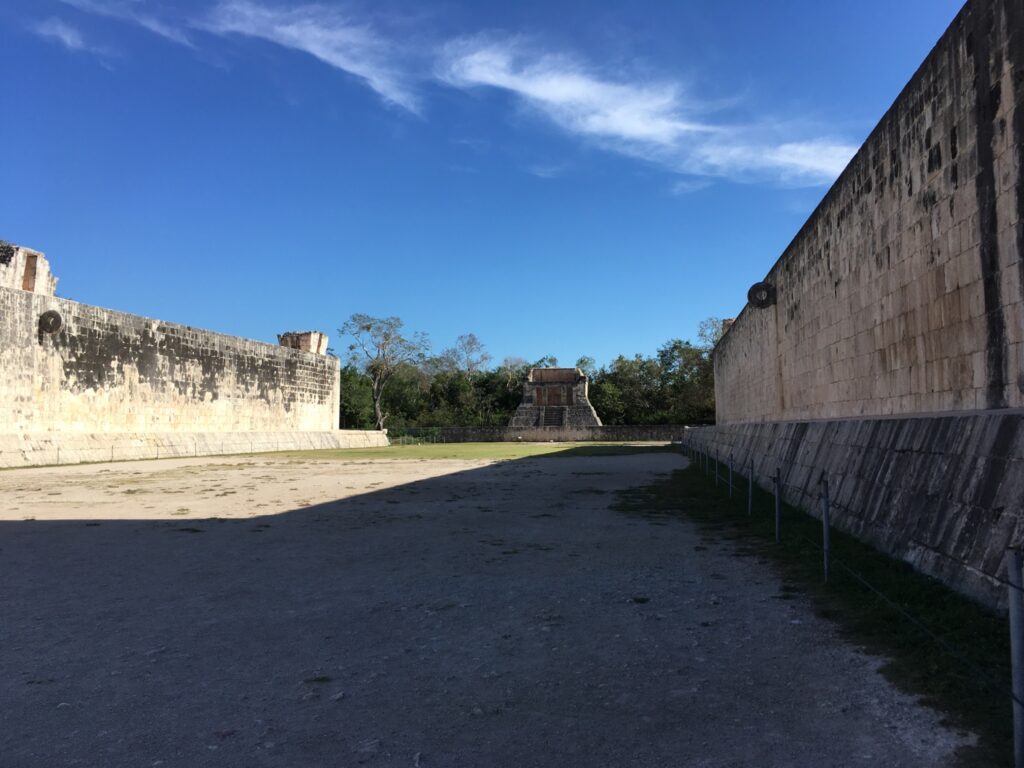
The Great Ball Court is physically unlike an ordinary human-scale sporting venue. Its enormous playing alley, approximately 24-foot-high rings, broad wall tops, monumental end temples, elevated buildings, restricted access, and celestial alignments make it simultaneously a ballcourt and a ceremonial performance complex.
The scale is not evidence that ballplaying did not occur there. Instead, athletic play occupied one component of a much larger ritual environment.
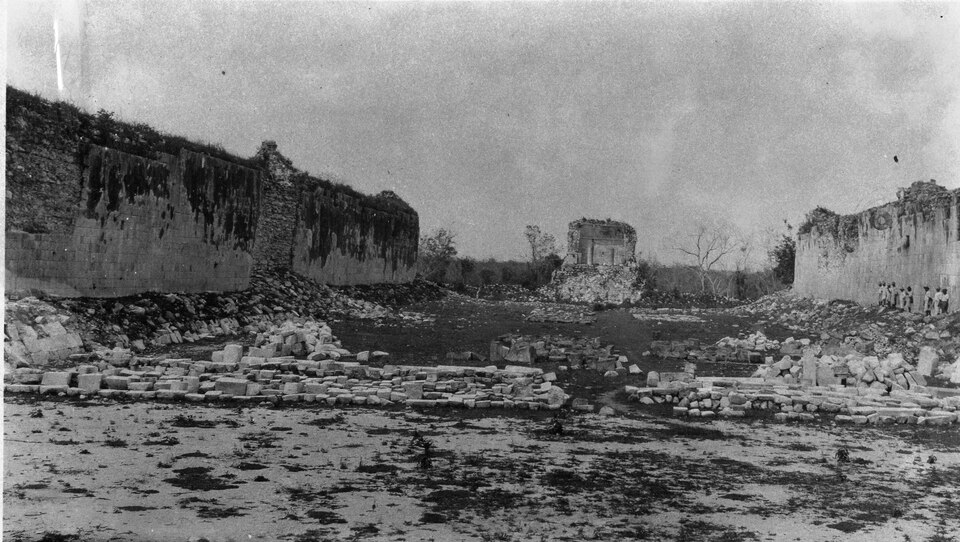
The upper architecture is especially important. Six substantial buildings occupied deliberate positions along the court walls. Modern reconstruction has obscured their original relationship, particularly where badly collapsed structures were reconstructed from limited remains. Maudslay’s early plans and photographs preserve architectural information that is no longer obvious at the site.
The six structures correspond to the six Houses through which the Heroes pass during the Xibalba trials.
3 The Six Houses of Xibalba
The six principal wall-top positions are reconstructed as the houses or ordeals of Xibalba. The sequence runs three stations along the west wall and then crosses to three along the east wall:
1. Dark House — southwest
2. Flint / Blade House — west center
3. Cold House — northwest
4. Jaguar House — southeast, Upper Temple of the Jaguars
5. Fire House — east center
6. Bat House — northeast
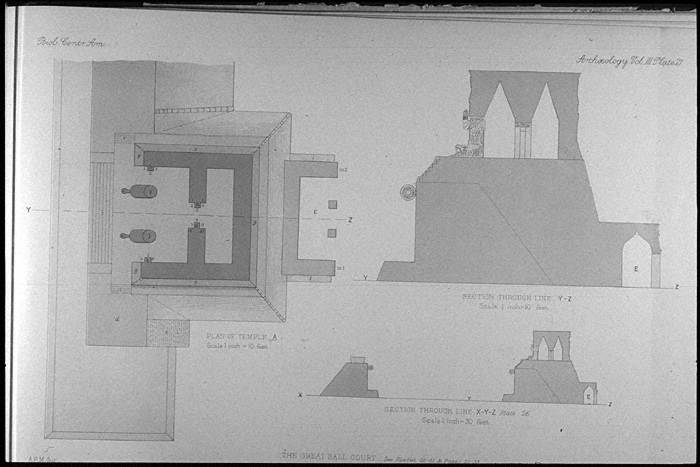
This 1–2–3 / cross / 4–5–6 route places Jaguar naturally in position 4. The surviving architecture demonstrates that these were not five miniature boxes surrounding larger Jaguar House. The Houses were substantial, human-scale structures of equal size.
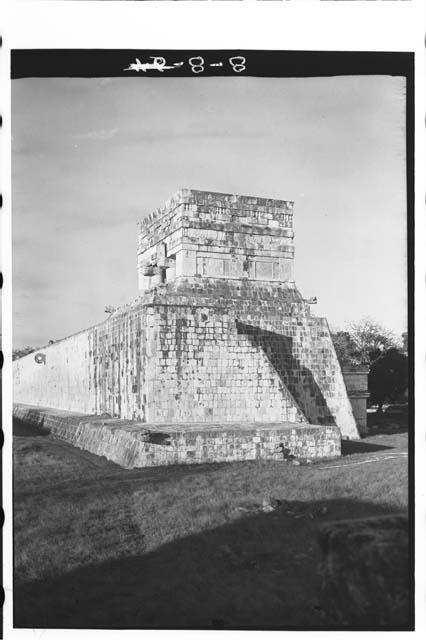
Maudslay’s documentation of the Jaguar House below shows that side step access (directly centered on the 16 foot 6 inch wall platform) was altered or obscured during later reconstruction. Originally, performers could walk into the elevated House without climbing the monumental steps on the court-facing wall. The court façade steps were therefore the visible ceremonial front, while lateral access allowed performers to enter safely.
The trials were not performed consecutively in a single trip along the wall. Each House represented one night spent, after a full day of playing ball.
A performer emulating the Heroes entered the appropriate House and remained there overnight. At daybreak, the Heroes would emerge alive before the assembled audience, reproducing one of the narrative’s recurring dramatic events: the Lords of Xibalba expect the Heroes to have died during the night, yet they emerge again in the morning.
4 Dark House: The Missing Southwestern House
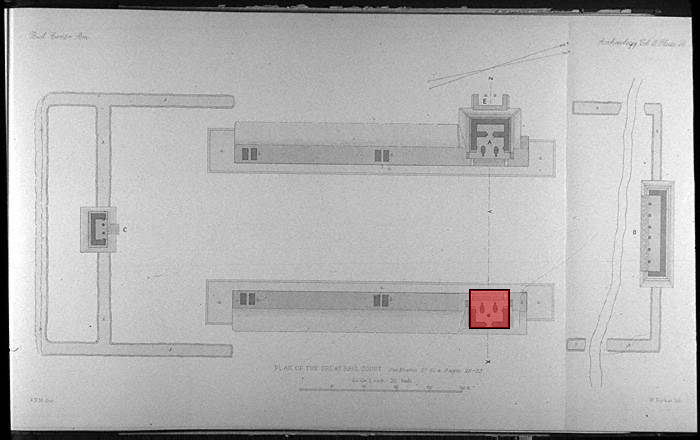
Dark House occupied the southwest position. This House was not simply a dark room. Its architecture interacted with celestial light. The House was aligned so that sunlight could enter the otherwise darkened structure, illuminating the hemispherical monument under specific solar conditions. The effect allowed the movement of light across the carved surface to become part of the ritual reading of the object.
The Popol Vuh’s Dark House episode itself revolves around controlled and deceptive light. The Heroes are ordered to preserve a torch and cigars while making them appear to burn. This is impossible, so they use red macaw feathers to provide the visual substitute for flame. Dark House therefore combines darkness, artificial light, celestial light, and the first night of the ordeal.
The western wall was heavily disturbed before modern reconstruction. Post-Maudslay photographs show substantial collapse.
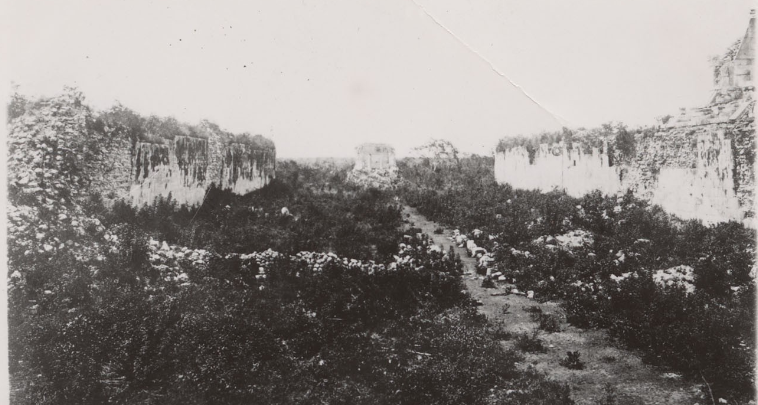
It was noted that The Great Ball Court Stone—a large hemispherical monument—was recovered from the southwest portion of the court and is proposed as an object originally associated with Dark House. The Great Ball Court Stone strengthens this reconstruction. The 1989 report places its 1923 discovery at the south end of the court, while Wren’s 1991 review preserves Morley’s later, confused reference to a “round roughly spherical altar” west of the south end of the west wall. [1][4] The exact provenience was lost, but it is assumed by the author to indicate that the court stone toppled backwards off of the southwest wall when Dark House collapsed. The Court Stone’s broken condition is compatible with collapse from an elevated structure.
The hemisphere is believed to have been placed as a record and commemoration of the completion of the ball court as a ritual centerpiece. If the building utilized solar equinox backlighting, as proposed by Jose Hutchim Herrera, this would create a bright rim by moving illumination across its curved carved surface.
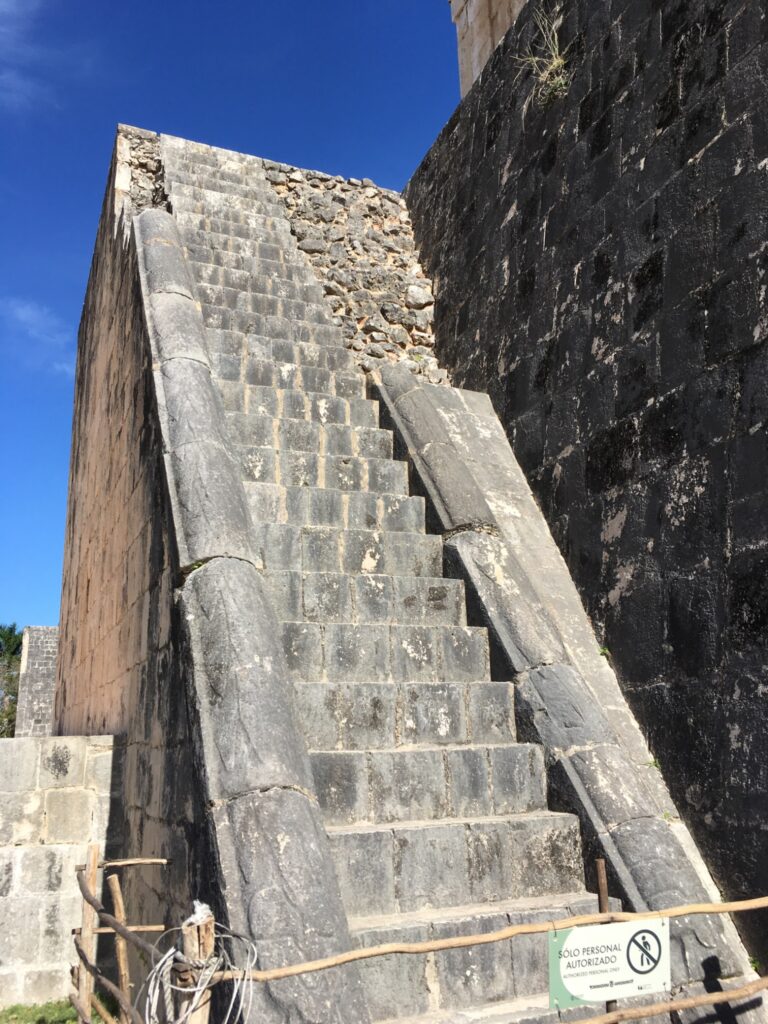
The Dark House episode in the Popol Vuh centers on deceptive light: red macaw feathers substitute visually for a burning torch. [5] Red macaw-feather decoration is therefore expected in the original construction at Dark House. The author has noticed sculptural feather-like elements are now incorporated into the reconstructed stairs near the Jaguar complex. These are interpreted as displaced material whose original context was lost in collapse and restoration; all of the stair alfardas elsewhere at the site provide a useful comparison. They are broad, flat, and sloping, even when carved with decor. The feathers shown here are believed to belong to Dark House and were likely painted red originally.
An edited plate is shown below to demonstrate the proposed dimensions and location of Dark House.
5 Flint, Cold, Jaguar, Fire, and Bat Houses
The people utilizing the wall tops are interpreted as trained priests or ritual performers rather than general spectators. Access was tightly controlled through the four-stair system, one at each end of the walls. The upper Houses therefore functioned as restricted ceremonial workspaces from which effects could appear mysterious to the population below.
The remaining Houses reproduce the escalating dangers of the Xibalba trials.
Flint House
Flint House corresponds to the second trial. Blades form part of the surviving South Temple narrative in precisely this portion of the six-part sequence.
The performance required the appearance of moving or threatening blades while allowing the Heroes to survive the night. Perishable mechanisms could have operated swinging blades within the substantial House architecture while actors remained safe in the other section and the audience observed the effect from below.
Cold House
Cold House corresponds to the third trial. The South Temple preserves wind imagery in the corresponding portion of its narrative. It is believed that wind whistles and potentially water whistles were utilized for effects at this house, in addition to pebbles being used to simulate the sounds of hail. This was performed secretly in the rear chamber, allowing the sounds to echo outward into the court.
The Popol Vuh describes extreme cold accompanied by howling and whistling wind. Sound-producing instruments and other simple effects could reproduce the sensory experience of the episode within the acoustically powerful court.
Jaguar House
The Upper Temple of the Jaguars is the monumental fourth House. Its enclosed rear section was a temporary holding space for a live jaguar during major ceremonies and equinox events. The animal could be brought up the night before the ceremony, held in the rear section, and then removed afterward. The Jaguar House episode itself is well suited to this arrangement: the jaguars crunch animal bones while the Lords of Xibalba believe the Twins are being eaten.
Jaguar imagery seen here also occurs in the corresponding fourth section of the South Temple narrative.
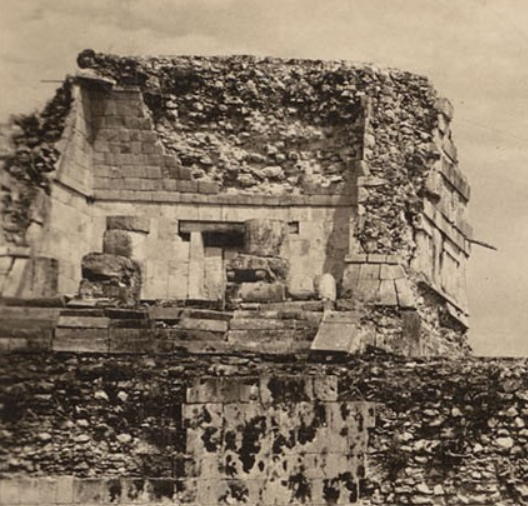
A live animal, bones, darkness, and the acoustics of the court could reproduce the scene without placing performers directly into contact with the jaguar. The wooden elemetns discovered by Maudslay in this House is believed to have been used as part of the jaguar handling process. The beams were not used to support the actual stone structures. Maya builders were wise enough to know that wood did not support megalithic stone structures. Nowhere else do we see wooden supports being used to support stone roofing at the site.
The author’s personal belief for their eventual collapses is the back heavy nature of the open faced structures.
Fire House
Fire House was not a momentary flame effect. The fifth trial also lasted through the night. Fire therefore had to be maintained for hours while the Heroes remained inside the rear section and subsequently emerged alive at daybreak. The location of Fire House above the east ring can be seen below. Also note the drainage hole inside the monument wall itself. These led to the large water basins that are fitted at the ends of the courts water channel, which are currently referred to as the “benches”. These were incorrectly converted to stone topped structures during early 1920-40’s reconstruction. This is likely because the benches had filled with stones when the Houses collapsed.
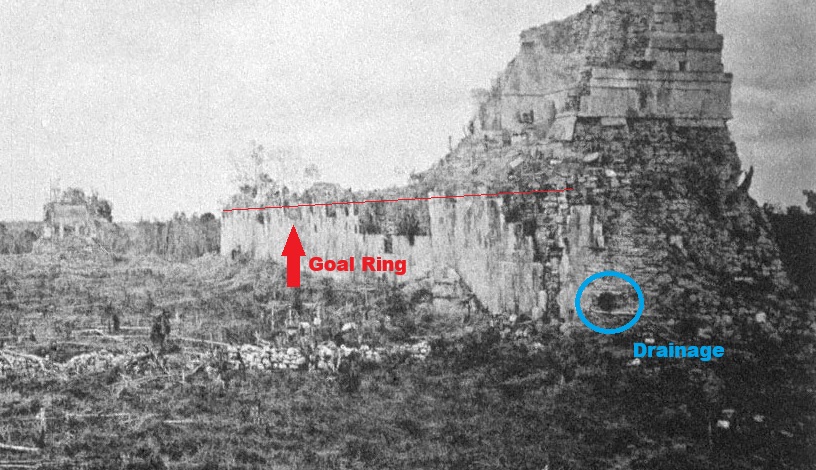
Drains for the basins and channels were also removed during this early reconstruction period. This can be seen in the H-shaped masonry area in the photo below. After the reconstruction, these basins underwent an excavation in 1940 and were then refilled with soil, instead of the incorrect stone top placed previously.
There is also a missing drain hole from the inner monument that is supposed to run directly through the steps and empty into the basin shown below. It is shown circled in blue in the image above.
Bat House
Bat House formed the sixth and final night. The surviving South Temple imagery includes a bat in the sixth portion of the sequence.
Inside the House, sound instruments or even actual bats could have created the sounds of a chamber filled with bats. Live bats could potentially have been held in the rear section and released during the re-enactment.
Unlike the preceding Houses, this ordeal ends with Hunahpu actually losing his head. Bat House therefore marks the transition between the six-night House cycle and the events subsequently enacted on the open court.
6 Six Nights and the Seventh Day
There is no seventh House. After the sixth night, the performance moved from the elevated Houses to the Great Ball Court itself.
The court then became the stage for the remaining narrative: Hunahpu’s replacement head, the ballgame deception, recovery of his actual head, the subsequent deaths, the grinding of their bones, their placement in the river, resurrection of the Twins, and their return in disguised form. This is explored further in The Great Ball Court Stone section below.
This explains why several architectural features of the playing alley have ritual functions beyond ordinary ballplay. The court’s long water-filled side features served two purposes. Practically, they restricted runaway balls within an exceptionally large playing field. Ritually, they provided the river required by the narrative.
After the Twins’ bodies are destroyed and their bones ground, their remains are cast into the river. The court therefore already contained the physical setting required to enact this portion of the story.
The drainage basin at each end likewise belongs to the court’s functioning water collection system, rather than being a simple drain feature. This ensured that water was available for ball players and spectators at the court.
The seventh day activated the entire lower court: the playing field, water, South Temple, ballgame equipment, and ritual props.
7 Hunahpu’s Removable Head
One of the best-preserved human figures on the South Temple provides an important clue to the mechanics of the performance. Most human faces are destroyed, leaving little more than feet and upper fragments. A single Hunahpu representation, however, preserves an unusual apparatus surrounding the neck and upper chest. It has previously been described as an enormous butterfly chest plate.
Its form and location on the body is better explained as part of the removable-head performance, especially since this atypical face corresponds to the exact style used to represent this portion of the mythology on The Great Ball Court Stone. Notice that rabbit ears are also included on the figure. The rabbit is a core part of the squash head portion of the myth. Hunahpu also carries an equipment bag and the serpent-style paddle used by ball players during this time period (also seen in court relief carvings).
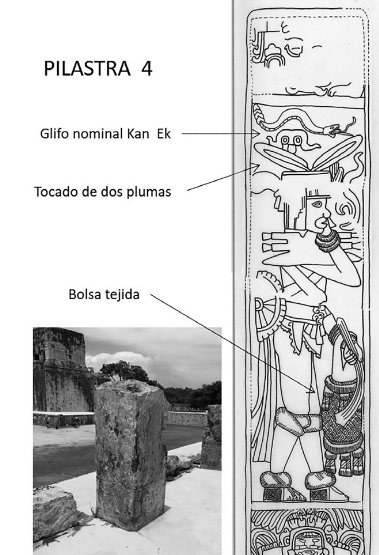
The same neck/chest apparatus occurs repeatedly on other representations of Hunahpu in the South Temple. Therefore, it was not limited to being worn only during the period in which he possessed the squash replacement head.
This allowed for a human-looking artificial head that could conceal or protect the performer’s actual head. The bat could then visibly bite off or remove the false human head without endangering the performer. Afterward, a squash or pumpkin replacement head could be attached to the same support. During the subsequent ball court deception, the replacement would break, allowing the human head wearing it to be revealed beneath it.
The repeated apparatus thus functions both as a character identifier in the carvings and as practical equipment capable of producing the narrative’s otherwise difficult head transformations. It can also be found in The Ossuary (see related article).
8 The South Temple as a Continuous Account of the Six Trials
The South Temple contains six carved pillars. The number corresponds to the six Houses, but the pillars should not be read as six isolated labels. Their sides blend one House episode into the next, forming a continuous narrative. The seven openings of the building’s architecture represent a space for each of the seven days.
The basic composition of the pillars remains remarkably consistent. Above the human narrative is a repeated heaven/sun god character. Below it is the repeated underworld/Chaac register, including feathered-serpent imagery. Between these fixed cosmological zones are the changing human figures and events. The structure is therefore:
SKY/SUN GOD (also seen identified by wings and a matching sun symbol on the chest in two Ossuary statues)
HUMAN NARRATIVE (Hero Twins)
DEATH GOD (believed to be Chaac due to Ossuary glyphs)
The changing imagery in the human narrative scenes identifies the progression of the trials. Several surviving anchors establish the sequence:
- Pillar 2 East — blades, corresponding to Flint/Blade House.
- Pillar 3 West — wind, corresponding to Cold House.
- Pillar 4 South — jaguar, corresponding to Jaguar House.
- Pillar 6 South — bat, corresponding to Bat House.
Pillar 1 is too damaged to preserve comparable Dark House imagery, while much of Pillar 5 is missing. These symbols occur in the correct narrative order to match the House trials. The imagery between them provides the transitions and additional events rather than merely repeating the name of each House.
The South Temple is therefore a monumental stone account of the same six-night narrative enacted by the buildings above the court.
9 Ballplayer Equipment and the Court Reliefs
The Great Ball Court reliefs preserve specialized ballplayer equipment rather than generic warrior equipment.
Players carry protective padding, handstones, equipment bags, and a distinctive long curved implement with a serpent-like form. The latter is repeatedly shown as part of the ballplayer’s equipment and functions as ball retriever, deflection, and striking.
The court reliefs also preserve the narrative relationships among ball, head, death, vegetation, and regeneration. The famous decapitation imagery is therefore not evidence that losing players were routinely executed after ordinary matches. It belongs to the mythological story enacted by the complex.
10 The Great Ball Court Stone and the Dated Performance
The Great Ball Court Stone is a hemispherical limestone monument approximately one meter across. Its relief areas repeat the ballgame, decapitation, head, serpent, and regeneration vocabulary of the court. Its rim carries twenty-four glyph blocks. Published work anchors glyph 5 as a ballgame event and glyphs 6–7 as 11 Kimi 14 Pax; it proposes K’ak’upakal at 21–22 and identifies the Chichén Itzá emblem/title at 24. Wren proposed an A.D. 864 Long Count equivalent for the Calendar Round. [1]
The pictographic reading is:
1 — One Hunahpu, the initial ball-playing chief
2 — Xibalba is disturbed by the ball-playing
3 — Death of the first generation
4 — Birth of Hero Twins
5 — Ballgame event (known published anchor)
6–7 — 11 Kimi, 14 Pax (known published date; proposed A.D. 864 placement)
8 — Performance / gameplay / enactment marker; heavily eroded
9 — Ballgame equipment: two balls, a handstone, and the snake paddle’s flat surface
10 — Hunahpu’s head is severed and placed at the ballcourt
11 — Hunahpu receives the squash/pumpkin replacement head
12 — Rabbit used in the deception against Xibalban’s; real head retrieved *Note: This block is INFERRED due to the missing glyph.
13 — Squash/pumpkin breaks during resumed play * Note: This block repeats the two ball equipment vocabulary
14 — Fire pit/oven and the deliberate death of the Twins
15 — Bones/remains processed and cast into the river
16–17 — Returned Hunahpu and Xbalanque in their disguised wandering-performer forms
18 — Return to Xibalba
19 — Conclusion of the Xibalba episode; badly degraded, with an open rectangular form and circles above
20 — lu-bat expression / dedicatory transition
21–22 — K’ak’upakal (published proposed identification)
23 — Completion symbol
24 — Chichén Itzá emblem (published anchor)
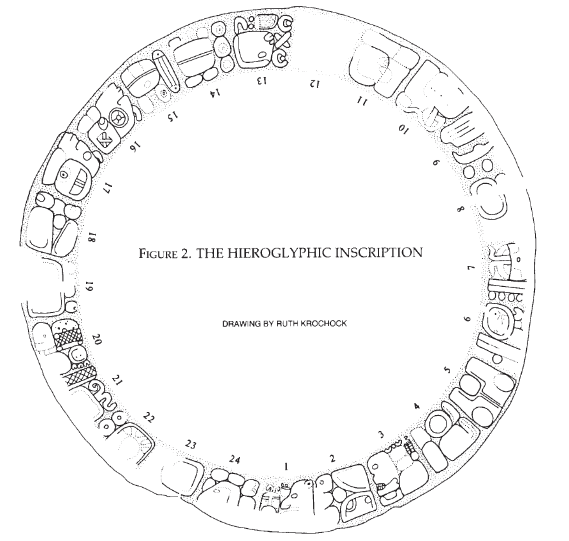
Read continuously, the inscription becomes a compressed ceremonial history: One Hunahpu plays ball; Xibalba is disturbed; death of first generation; the Hero Twins; ballgame; date; enacted/played; ballgame equipment; Bat House beheading and head placed on court; squash-head substitution; rabbit deception; resumed play and victory; voluntary death in the fire pit; bones crushed and put in river; return of both Twins; return to Xibalba; conclusion of the Xibalba episode; then a dedicatory transition naming K’ak’upakal and Chichén Itzá. *Note: The repeated depiction of two balls in the proposed readings of glyphs 9 and 13 is particularly notable because it also parallels the ballgame equipment vocabulary visible in the reliefs.
Particularly important is the recurring visual distinction between Hunahpu and his brother. Hunahpu carries the identifying X-like mark associated with his decapitation and reattachment.
11 The North Temple as the Royal Place of Honor
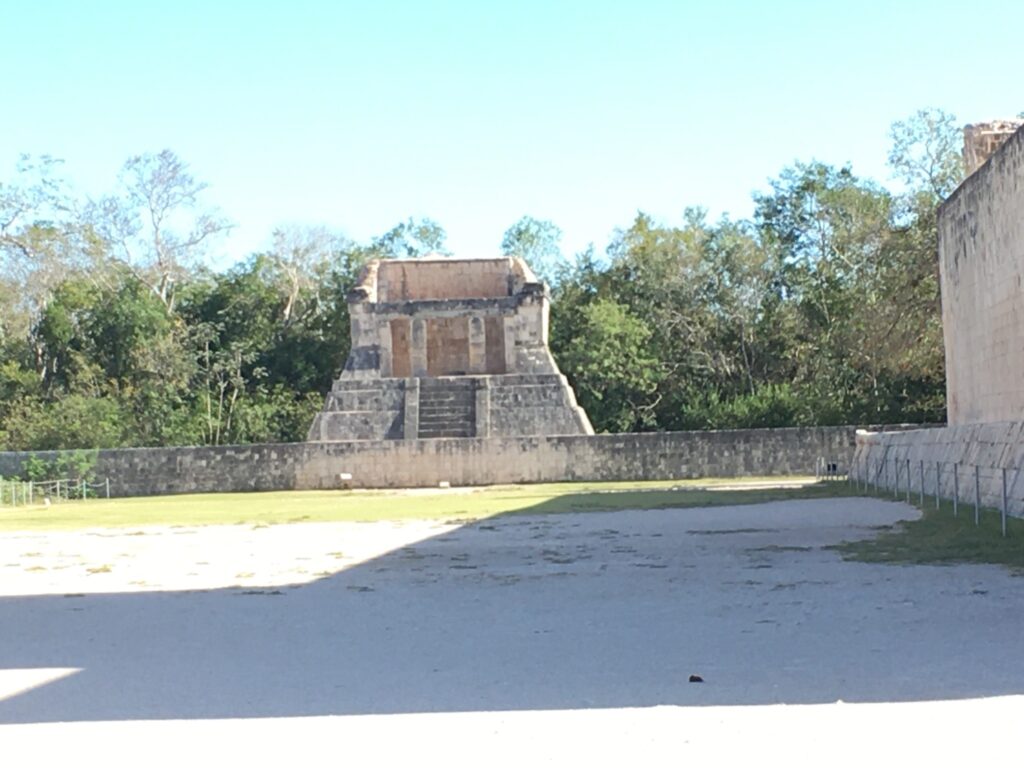
The North Temple, commonly called the Temple of the Bearded Man because of the prominent bearded figure in its relief program, is proposed as the chief/king’s place of honor for observing the ballgame and the wall-top theatrics. Published descriptions confirm that this temple closes one end of the Great Ball Court and contains unusually rich interior relief sculpture centered on the so-called bearded figure. [7] Its elevated, axial position makes it the natural royal viewing and ceremonial station in the reconstructed performance system.
12 A Multi-Sensory Ceremonial Machine
Taken together, the Great Ball Court functions in this reconstruction as a multi-sensory ceremonial machine. Architecture controls access and sight-lines. Performers occupy the wall-top Houses. Dark House manipulates sunset and red-feather imagery; Flint House flashes moving blades; Cold House produces wind, water, and hail sounds; Jaguar House uses a live animal and bone-crunching acoustics; Fire House erupts in real flame; Bat House uses bats, darkness, and a decapitation illusion. The ballplayers below wear specialized equipment matching the carved narrative, while the chief/king observes from the North Temple. It is also believed that players painted themselves black and white (and played with those colors of balls) to represent the opposing Xibalba and Hero teams.
13 The Ossuary: The Earlier Generation
The Great Ball Court preserves the story of Hunahpu and the later generation, but the narrative does not actually begin there. A second monument at Chichén Itzá, the Ossuary, preserves the preceding story of One Hunahpu and Seven Hunahpu and their encounter with the Lords of Xibalba.
Inside the summit sanctuary, four carved pillars depict encounters between the Hunahpu family and figures identified by their serpent staffs as Xibalbans. A detached Hunahpu head and ballgame-related imagery were associated with the sanctuary altar. Beneath this sanctuary, the central shaft contains seven distinct graves before opening into a much older collective burial cavity described by the excavators as the “mouth of the underworld.”
One pillar also preserves a pictographic glyph sequence regarding the first generation. The shape of the composition is itself significant: the inscription proceeds horizontally in the human world narrative before turning downward. The descending sequence corresponds to events occurring within Xibalba, including the false effigies, hot-stone deception, a badly damaged position corresponding to Dark House, the deaths of the two brothers, and One Hunahpu’s severed head at the roadside calabash tree.
The long-nosed supernatural appearing near the end of this descending sequence is represented with the two brothers immediately before the head by the road episode. Monumental versions of this same being (often called Chaac) dominate the corner architecture of the Ossuary and also occur elsewhere at Chichén Itzá. The Ossuary therefore provides both generations of narratives related to the Great Ball Court.
References
1. Linnea Wren, Peter Schmidt, and Ruth Krochock. “The Great Ball Court Stone of Chichen Itza.” Research Reports on Ancient Maya Writing 25 (1989), 23–27. Mesoweb.
2. Mesoweb. “Tour of Chichen Itza,” Great Ballcourt discussion.
3. Mark Stevenson. “Mexico: Mayan ball court was celestial ‘marker’.” Associated Press / Phys.org, October 5, 2012, reporting José Huchim’s INAH work.
4. Linnea H. Wren. “The Great Ballcourt Stone from Chichén Itzá.” Sixth Palenque Round Table (1991), 51–58.
5. Allen J. Christenson, trans. Popol Vuh: Sacred Book of the Quiché Maya People. Mesoweb edition.
6. Eric Taladoire et al. discussion of Mesoamerican handstones; Journal de la Société des américanistes review noting direct association of handstones with Chichén Itzá ballplayers.
7. Great Ball Court / Temple of the Bearded Man site descriptions; Maudslay archive and modern site summaries.
8. Alfred P. Maudslay. Biologia Centrali-Americana: Archaeology, Vol. III, Chichén Itzá plates 26–51, especially Plate 28. Mesoweb digital archive.