
The Southern Ballcourt Panels: War, Death, and the Hero Twins – By Donna Evans
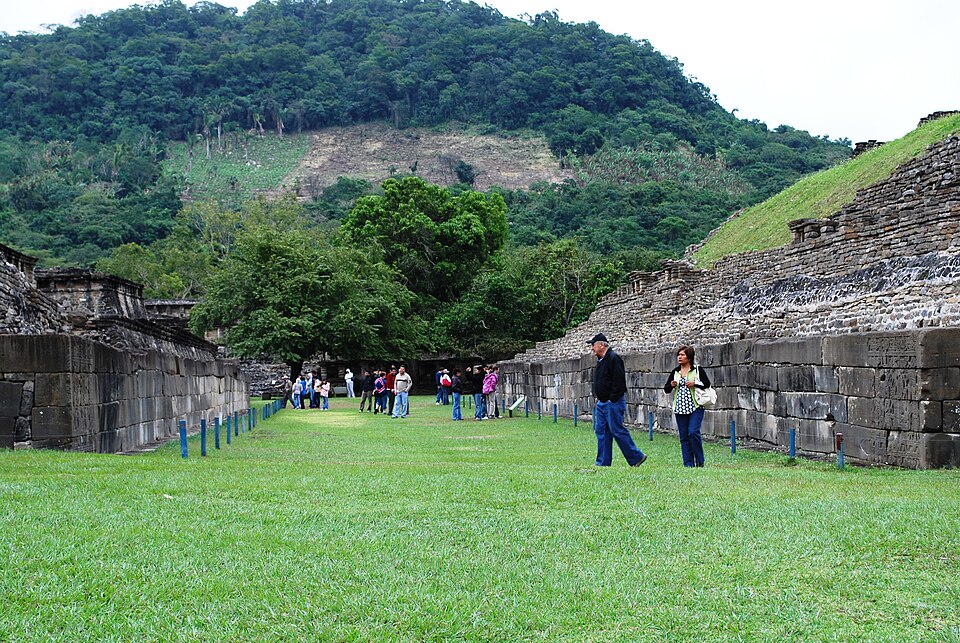
The six carved panels of the South Ballcourt at El Tajín are commonly discussed in relation to ritual, sacrifice, and the Mesoamerican ballgame. Viewed together, however, they appear to tell a much more specific story. Repeated symbols, earrings, gods, body positions, weapons, and resurrection imagery connect the panels into a continuous narrative. I believe that narrative preserves a version of the story later recorded in the Popol Vuh: the conflict surrounding Hunahpu and Xbalanque and the people associated with them.
Importantly, the carvings do not appear to show a normal ballgame followed by the routine sacrifice of a player. They instead depict two opposing groups, warfare, death, resurrection, renewed confrontation, and finally the execution of the leader associated with death and sacrifice.
*Note: All images below have been colored by the author to help identify central figures and actions occurring in the narrative. The artist of the original drawings and the colors of the original carvings are unknown.
1. Mediation Fails — War Begins
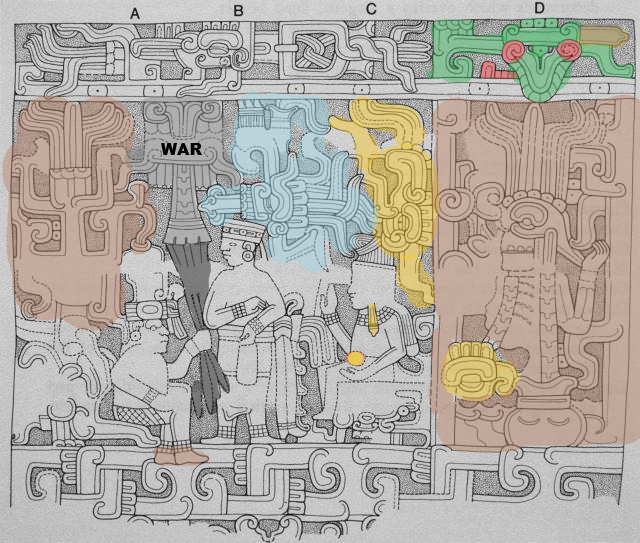
The first panel appears to establish the original conflict. On the top right, in the upper carving, we see a snake with its tongue out. This indicates the beginning of the narrative panels – the snake header is seen one other time on the last panel with no tongue. On the right side of the image, we also have Death. Near his lower body, there is a mask figure representing the Hunahpu deaths that have already occurred.
The person on the far left has spears in his hand, his feet are in the Underworld, and a large system is connected to his head. The system attached to his head shares the exact same feathered headdress as Death. I believe this to mean that this man was bringing death to people, possibly by sacrificing them.
The scene appears to represent an attempted mediation that ultimately fails (note the war emblem between the Death Bringer/Xibalban and the two other people – also note the masks above them). The narrative suggests that the two parties on the right wanted peaceful resolution, as indicated by the ball in the hand of the man on the right. Also, note his long pointed earring.
2. Death of Hunahpu and Xbalanque
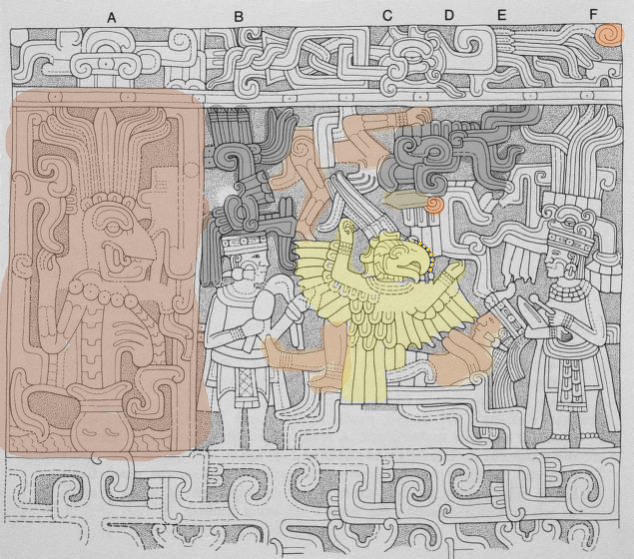
The second scene moves directly into the consequences of the conflict. Priests summon with sound instruments, while Xbalanque lies beneath the Maize God (with seven dots on the beak). Hunahpu is shown above, likely with his head in the mouth of Kama Sotz’ and his foot in the mouth of Chaac. Notice the reincarnation intentions is being shown in the poses of both brothers, one straight leg and one bent
We see the resurrection spiral (colored in orange) just below the Kama Sotz’ and on the top right upper carving, likely representing the pumpkin/squash head replacement performed by Xbalanque. Death is represented beyond the wall in the left of this image.
3. Resurrection of Hunahpu
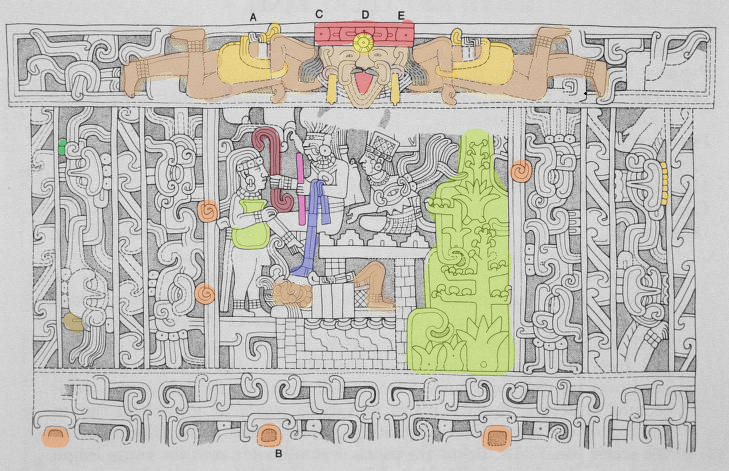
The upper carving is particularly sophisticated. It can be viewed simultaneously as one frontal head and as the two faces of the brothers. Their characteristic earrings remain visible on either side. The composition combines the two individuals into a single supernatural resurrection image. Note that the Twins carry their ballplayer bags in this image.
It is at this point, the resurrection officially begins. Hunahpu is shown as entombed. His placement in this image indicates that his body had been placed into its grave at the Ossuary. Notice the common burial chamber is immediately below him. His placement in the shaft is just above the cavern, and below the Ossuary.
The first step of the resurrection is indicated by one spiral on the right, beginning with the collection of the agave cactus. The second step is indicated by two spirals on the left, the gifting of Pulque to celestial beings, possibly Bacabs. The third step shows three underworld doors opening.
Owl masks are seen at the sides of this image. The right side has a mask with seven dots (in gold) for One Hunahpu through Seven Hunahpu.
* Note the blue colored fabric and the two objects being presented by the celestial beings. The rod shaped one, colored in magenta, will reoccur later. The curved item could potentially be a pitz paddle.
4. Resurrection of Xbalanque
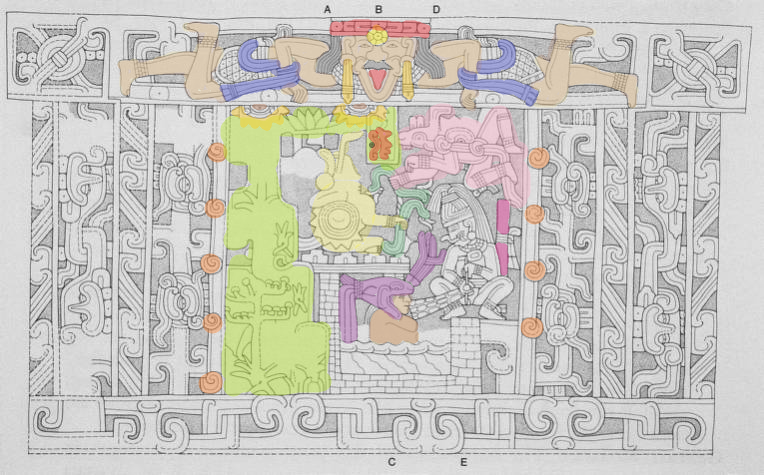
Once again, the upper carving shows the paired resurrection-posed twin figures. However, their equipment is not identical between the resurrection panels. In this one, they appear with fabric draped over their arms (colored in blue). It’s the same as the fabric held by the Bacab in the previous panel. This may represent a change in status; the brothers died as ballplayers but return as warriors or leaders.
In the fourth step, indicated by four orange spirals, we see the Rabbit God (colored in pink). From the sky, he allows a serpent to bite the seated yellow celestial being (Bacab). The Bacab then holds a snake towards a bloodletting man, who is carrying the magenta rod on his back. Xbalanque is shown in the Ossuary shaft, wearing the fish headdress colored purple and a missing arm. This feature will be important later for identification.
This imagery corresponds remarkably well with the resurrection episode of Hunahpu and Xbalanque in the Popol Vuh. After their deaths, their bones are ground and cast into water, where they appear as fish before returning in human form. – The author would also like to note that Xbalalque appears to be missing an arm.
The fifth step is indicated by the five spirals colored in orange. This one is slightly unclear, as the carvings are missing in places, but the lower half contains another agave cactus. The upper portion appears to have two watchful eyes from the sky with an agave where a nose would be. There is also a mask with an eye to the right. The agave imagery seems to touch the yellow Bacab, indicating a potential interaction.
5. Confrontation
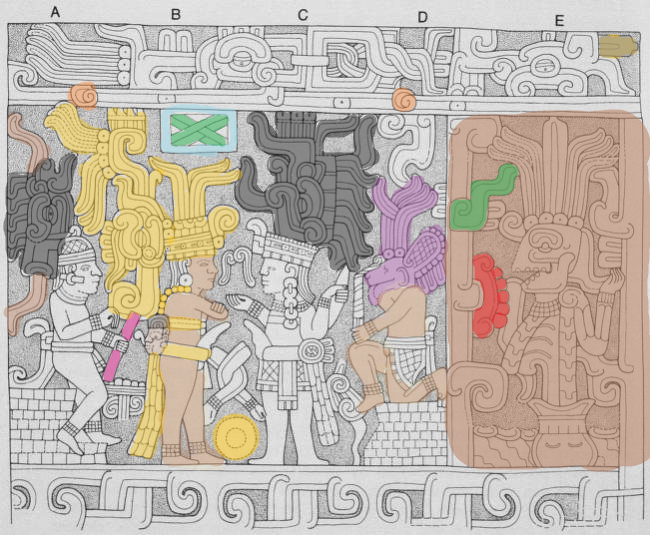
The fifth panel returns the resurrected brothers to the human conflict. Here the opposition between the two groups becomes unusually explicit. Hunahpu (marked with his X) is clearly angry and is seen with One Hunahpu’s head on his belt (as he is shown at Chichen Itza). The man behind him carries the magenta colored rod. A bow with a mask on it is behind him, indicating the ongoing warfare. The opposing man hides a blade behind himself while the two speak.
Behind the opposing man is Xbalanque. His is shown incognito with a feline head, appropriate to Xbalanque’s long-recognized jaguar association. He is missing an arm, as noted earlier in the resurrection relief. Both brothers in this image also have the resurrection curls above them, colored in orange. Xbalanque’s position is also extraordinary: he kneels.
No other principal figure in these six reliefs kneels in this manner. Position is part of the pictorial language of the panels—gods appear above humans, people stand, and dead lie horizontally. The unique kneeling posture therefore indicates deliberate subordination. In the upper header, the jaguar on the top right appears with a blade. It appears he may have entered the opposing faction’s position deliberately.
6. Execution
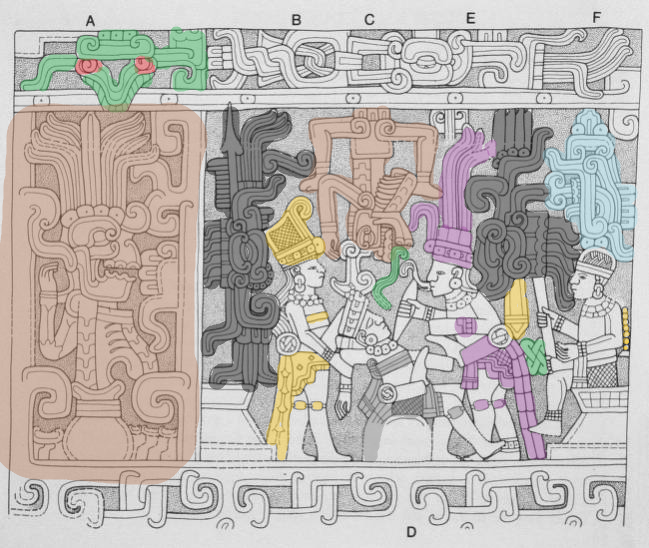
The final panel resolves the conflict through execution.
The Death Bringer/Xibalban is restrained by Hunahpu (the second resurrection) while the once reincarnated Xbalanque holds a blade to his throat (note the familiar headdress and strange bracelet at the wrist, potentially indicating a false hand).
The seated figure behind him extends his leg directly into the action. His foot forms the distinctive X shape associated with the first resurrection of Hunahpu and physically pushes against Xbalanque. The seated figure also carries a mask/banner with the original earring attached and has seven dots at his back, representing the original team of seven players that were killed.
A Different Story of the Ballgame
Read in sequence, the South Ballcourt reliefs preserve something considerably more complex than the familiar idea that Mesoamerican ballplayers routinely sacrificed the winner or loser of a game. The narrative instead appears to be:
attack and death of 7 players → warfare → death of twins → resurrection → “return” of the brothers → confrontation → capture and execution of the Death Bringer/Xibalban
This structure closely resembles the central conflict of the Popol Vuh. Ballplaying repeatedly brings Hunahpu’s family into conflict with Xibalba. The Lords of Xibalba are associated with killing, decapitation, deadly trials, and sacrifice. The second generation of brothers dies, passes through transformation, returns, and ultimately turns the power of death against the Lords themselves.
The El Tajín carvings may preserve an earlier visual version of this narrative, perhaps one retaining political or historical elements that were later expressed increasingly through mythology.
This translation also changes how the “sacrificial” imagery should be approached. A depiction of death at Maya ballcourts does not mean that sacrifice was a normal consequence of playing the ballgame. In fact, it was quite the opposite. They went to war because of their own people were killed after a ballgame with Xibalbans. The ballcourt is simply a core part of how the war started and was documented; it was not a place of regular execution or sacrifices.
Reading the Carvings as a Pictorial Language
What makes this interpretation compelling to me is not any single resemblance to the Popol Vuh. It is the accumulation of repeated visual information across all six panels.
The carvings repeatedly use earrings to identify groups, clothing to distinguish factions, X imagery to identify Hunahpu, feline imagery for Xbalanque, body position to communicate status and death, repeated spirals during resurrection, changing regalia after resurrection, divine figures during restoration, and weapons and banners to distinguish warfare from ballplaying.
Seen individually, the famous blade scenes can easily be presented as evidence that sacrifice followed the ballgame. Seen as part of the complete six-panel narrative, however, the blades belong to a much larger story of warfare, death, supernatural intervention, resurrection, and retaliation. That larger story is what I believe the artists of El Tajín intended us to read.
I believe the true history is that the initial seven were playing ball, and the Xibalbans had heard about or overheard their game. They played the Hunahpu and lost, then they killed the seven ballplayers. Eventually, the Twins were also heard about or overheard by the Xibalbans. They likely knew what had happened before (hence the later myth of them deliberately leaping into the fire), but they went anyway to try to achieve peace.
This is essentially confirmed by Panel 1 here. Hunahpu sat with a ball in hand, while the other man sat clenching spears with thoughts of death and his feet in the underworld. The symbol representing the people killed before was shown with Death, likely showing the prior knowledge of what happened. After the twins were killed, the warfare and sacrifices taken by the Xibalbans likely continued to cause war.
In the Popul Vuh, the Xibalbans had also ordered a heart removed from the mother of the Twins. It is noted that Ixquic was the supposed virgin daughter of a Xibalban lord who had miraculously conceived the twins from a severed head. As we know in the modern world, this is not possible. It is somewhat more likely that One Hunahpu fathered the children more directly – or – the twins were not closely related to the first team of ballplayers at all. After the death of the twins, two different men were likely chosen to take on their names and places and finally put an end to the warfare and sacrifice.
Image Reference
Alejandro Linares Garcia – Own work, CC BY-SA 4.0, https://commons.wikimedia.org/w/index.php?curid=9392987