
A Cretean Hieroglyphic translation by Donna Evans
Abstract
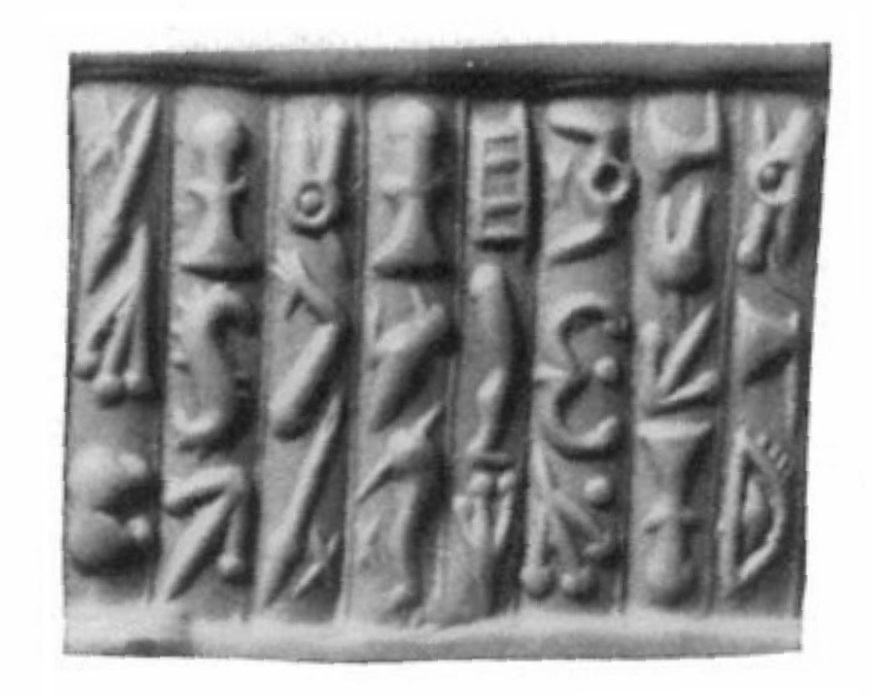
The unusual eight-sided agate seal AN 1938.1166, generally known as the Neapolis seal and catalogued as CHIC #314 / CMS VI 102, was acquired by Arthur Evans in eastern Crete. The Neapolis seal does not explicitly share any signs with the Phaistos Disc or Arkalochori Axe, however there is a very strong stylistic composition. It uses approximately the same type of pictorial language seen across the other Cretan Hieroglyphic material: recognizable human shapes, animals, body parts, plants and objects are combined into short visual messages. The seal’s individual faces were most likely reusable stamps for producing separate public signs, warnings and instructions.
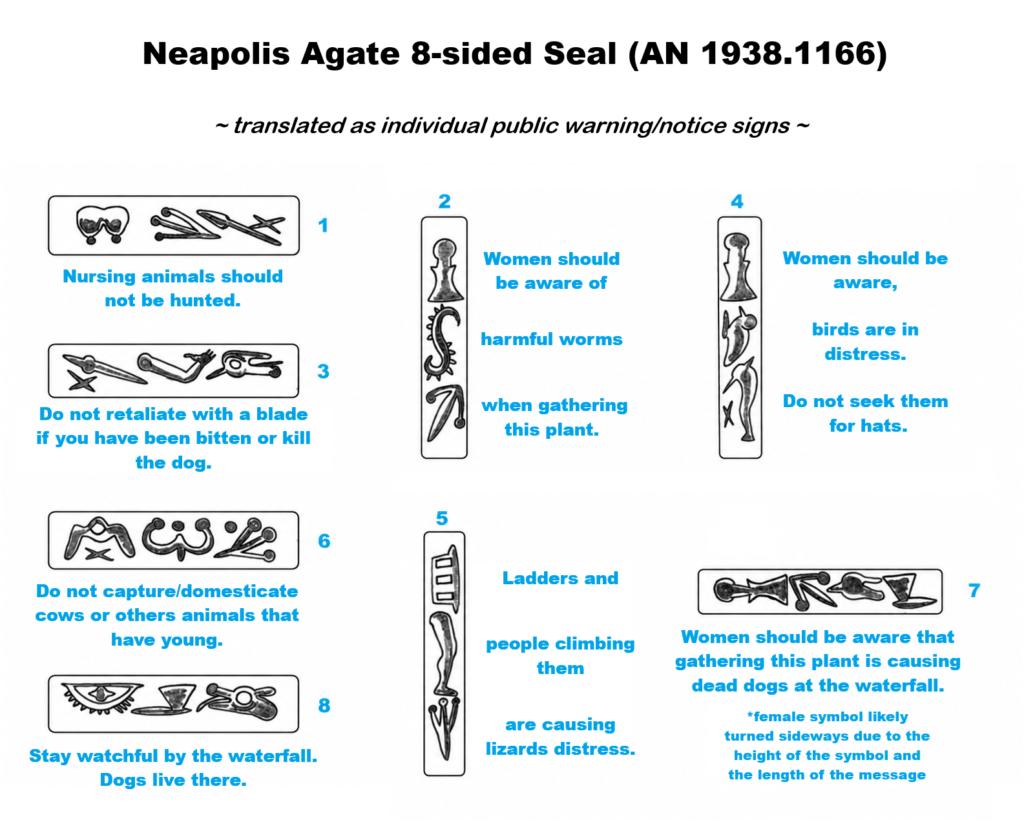
This interpretation also explains an otherwise peculiar feature of the seal: the inscriptions do not all have the same orientation. Some messages are arranged horizontally and others vertically according to the shapes of the signs and the available space on each sealing face. The tall female figure was seemingly turned lengthwise on one side to fit the device, while inversion of certain animals appears to communicate a change in their condition.
Comparable Minoan multi-sided seals were genuine stamping devices; impressions made by Cretan Hieroglyphic prism seals survive on clay, including administrative sealings and an impression stamped onto a pottery handle. A remarkable fourteen-sided prism from Archanes likewise contains numerous independent pictorial sealing surfaces. This particular eight-sided form therefore provided a practical way to carry a small collection of reusable messages on a single object.
Reading the Eight Signs
Several visual conventions recur across the signs. An X marks a prohibited action, while the orientation of an animal can change its condition: an inverted animal represents one that is dead or distressed (like the Phaistos Disc). Some signs reinforce one another—the same plant occurs in related gathering warnings, while dogs and the same apparent waterfall or location occur together on two separate faces.
The relationships between the individual signs are important. Signs 1 and 6 both protect animals while they are raising young. Signs 2 and 7 concern plant gathering. Signs 7 and 8 share both dogs and the same location symbol. Several others regulate unnecessary harm to animals resulting from ordinary human activities. Rather than eight unrelated sentences, they form a small and practical collection of community warnings and rules.
The Connection with Phaistos
The Neapolis seal makes more sense in the larger picture that emerged from my interpretation of the Phaistos Disc. It describes expanding agriculture and the effects accompanying it: planting, harvesting, movement through the landscape, interactions with animals and increasing human use of previously less disturbed environments.
Archaeology independently demonstrates the extraordinary growth occurring on Bronze Age Crete. Palatial centers, large urban complexes, storage facilities, workshops and increasingly organized agricultural production physically document a society supporting larger populations and making increasingly intensive use of its landscape. The great centers at Knossos, Phaistos and Malia are themselves monumental evidence of that transformation.
As agricultural communities and settlements expanded, encounters between people, domestic animals and wildlife inevitably increased. Seen in that setting, the Neapolis messages are remarkably practical. Do not kill nursing animals. Do not capture animals with young. Do not kill a dog simply because it bites. Do not take distressed birds for adornment. Be careful while gathering plants. Watch for dogs in particular locations. Be conscious of the small animals displaced by ordinary human activity. These are exactly the kinds of rules a growing community could use when its activities increasingly overlapped with those of the animals around it.
There is another conceptual connection with the Phaistos Disc. In my Disc analysis, orientation can communicate condition rather than creating an entirely different sign. Recognizing that convention helped make sense of the inverted animals on the Neapolis seal. A dog remains a dog when inverted, but its state has changed. This allows the pictures themselves—not an imposed phonetic reading—to communicate additional information.
My interpretation proposes that this was not an inscribed ornament or an eight-part text. It was a compact public-sign maker—eight reusable messages carried on a single seal.
Photographic Reference
Kenanidhs, Giannhs. The Arkalochori Axe and Its Siblings.