
Deciphering the Phaistos Disc – By Donna Evans
Reading the Disc
The Phaistos Disc is designed to be read as a continuous two-sided record. The narrative begins at the center of the first side, follows the spiral outward, and then reaches the edge of the Disc. The reader then flips the Disc over and continues to read from the center outwards.
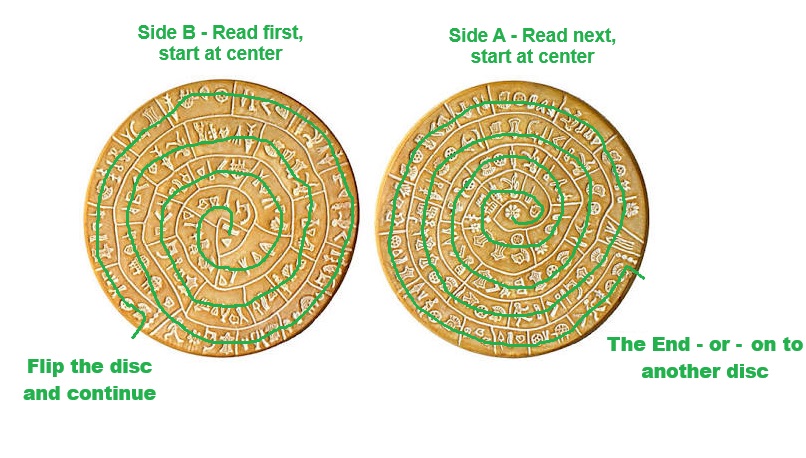
*Note: The line with 4 dots on the outer edge prevents the reader from following the spiral incorrectly. It also marks the end of the disc while also indicating continuation on the other side or the next disc.
It is also important to note that the narrative starts on what is now considered Side B. This is confirmed by narrative progression and the different block design at the center of the discs. Block 1 on Side B contains a triangular-shaped, enclosed block of glyphs to begin the story. Block 1 on Side A begins with an open spiral shape at the center, representing continuation from the previous side.
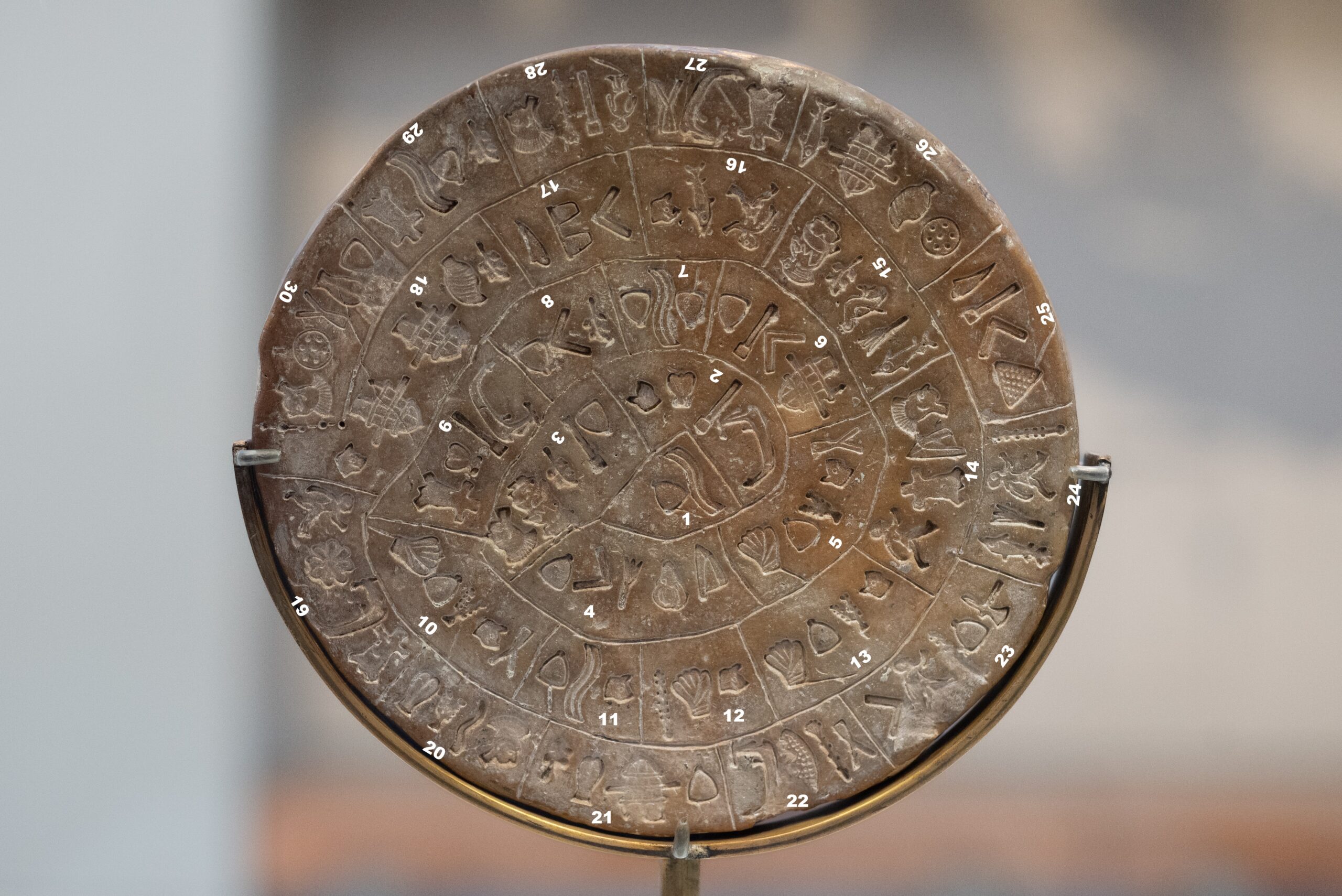
Translation
The disc begins with the discovery of agriculture and wild seeds growing on riverbanks, then Demeter promotes the spread of agriculture. Triptolemus repeatedly travels in response to ecological damage and expanding agriculture, fish, tool, timber, and shipbuilding demands.
The Carians become associated with stone-tool production, killing of snakes, water-based activity, and growing resource demand. The Disc also records Triptolemus and Demeter’s attempts at correction: limiting tool and ship production, warning against tree cutting and overfishing, and resting the riverbank cultivation fields.
The animal-tooth planting episode follows Triptolemus’ warning about dead lynxes and appears to reflect an attempt to replenish the animals rather than the later mistaken mythological interpretation of growing human warriors from teeth.
Block-by-Block Decipherment
| Block | Glyph sequence | Decipherment/narrative |
| 1 | Modified/wild seed • river | Naturally occurring or self-sowing riverbank seed is established. The modified seed may represent wild riverbank grasses/grain; its exact crop identity remains open. |
| 2 | Ship • collection • bee • downward-facing lynx | Ship-based bee collection/harvesting was associated with decreasing lynx numbers. |
| 3 | Seed • collection • olive tree • Demeter • Triptolemus | Demeter and Triptolemus begin the introduction/spread of deliberate seed collection, olive cultivation, and agriculture. |
| 4 | Seed • leads to • upward-facing bird • upward-facing ram/sheep • stone blade/tool | The spread of seed agriculture led to stress among birds and sheep and to the development/use of stone blades or tools. |
| 5 | New/increasing agricultural leaders or hunters • seed • branch club • lynx • prepared fish | As new agricultural settlements and their leaders/hunters increased, people sought seed, used branch clubs against lynxes to protect settlements, and consumed fish that also formed part of the lynxes’ food supply. Lynx numbers declined through direct killing and food competition. |
| 6 | Settlement • leads to • collection • seeds | Permanent settlements led to increased collection/storage of seed. |
| 7 | Modified/wild seed • river • ordinary cultivated seed | The original wild/self-sowing riverbank crop remained on one side while deliberate cultivation expanded on the other bank. The crops may represent wild riverbank grain versus olives or another crop. |
| 8 | Olive tree • leads to • seed | The Demeter-associated olive tree/cultivation produced further seed/fruit for propagation. |
| 9 | Ship • collection • bee • rest/stop | Shipbuilding activity associated with bee collection/harvesting paused or rested. |
| 10 | Continued leaders/hunters • seed • branch club • lynx • prepared fish | Leaders/hunters continue with the same practices: expanding seed agriculture, using branch clubs against lynxes, and consuming fish, maintaining pressure on lynx populations. |
| 11 | Modified/wild riverbank seed • river • lynx | Expansion of riverbank agriculture took over lynx habitat. |
| 12 | Tree-trunk/studded club • Leaders/hunters • lynx | Leaders/hunters now wanted heavier tree-trunk clubs for killing or controlling lynxes, escalating timber demand beyond smaller branch clubs. |
| 13 | Increasing leaders/hunters • seed • branch club • upward-facing lynx | Increasing numbers of leaders/hunters continue to seek seeds and used branch clubs against lynxes, leaving the lynx population in distress. |
| 14 | Walking Triptolemus • rest/stop • stone blade/tool • Carian | Triptolemus journeys to the Carians, to put a pause/stop on their production of stone blades/tools. |
| 15 | Upward-facing fish • upward-facing wild birds • domesticated birds • olive tree | Aquatic life and wild birds were suffering in connection with expanding domesticated-bird keeping and olive cultivation/use. |
| 16 | Walking Triptolemus • upward-facing aquatics • dead/inverted lynx | Triptolemus continues his journey to warn people on behalf of distressed aquatic life and the lynxes being killed. |
| 17 | Leads to • planting glyph • sharp animal tooth | Triptolemus’s warning about dead lynxes led people to plant animal teeth in the earth, apparently believing this could grow or replenish lynxes. |
| 18 | Olive tree • fire • larger city/double house • dead/inverted lynx | Expansion of olive cultivation led people to clear land by fire for a larger city, causing additional lynx deaths. |
| 19 | Walking Triptolemus • flower settlement • ship • rest/stop | Triptolemus journeys to the flower settlement to ask its shipbuilders to pause or stop shipbuilding. |
| 20 | Truth/connection • branch club • speared/dead snake • Carian | A connection is identified between branch-club use and the killing of snakes/reptiles by the Carian. |
| 21 | Olive tree • truth/connection • settlement • seed | A connection is recognized between olive cultivation and settlements seeking seed/fruit, likely including demand connected with olive oil production. |
| 22 | Ship • spiked fruit/product • weapon tree • prepared/beheaded fish | Shipbuilding, harvesting the spiked weapon tree, exploitation of the weapon tree itself, and killing/preparing fish for food were occurring together. |
| 23 | Leads to • walking Triptolemus • tree-trunk club • seed • axe/tree cutting | These activities lead Triptolemus to journey there to warn people about tree-trunk club production, seed/resource use, and cutting trees. |
| 24 | Upward-facing fish • upward-facing wild birds • walking Triptolemus • tree-trunk club | Fish life and wild birds remained stressed, so Triptolemus continued traveling to warn people about the tree-trunk clubs. |
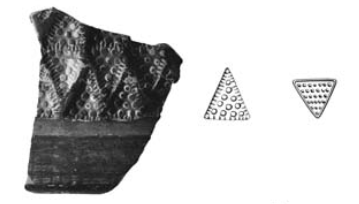
| 25 | Dimpled pottery • leads to • collection • animal tooth | Dimpled pottery led to increased collection of animal teeth. * Evidence for dimpled pottery interpretation is shown below. |
| 26 | Water • flame • settlement • fish | Cooking/fire activity in settlements was impacting fish populations. |
| 27 | Rest/stop • ship • prepared fish | A pause/stop is recommended for the fishing-related activity. |
| 28 | Standing person with line under • collection • weapon tree • Carian | The presence or threat of the Carian caused ordinary people to intensify harvesting of the weapon tree to make tree-trunk clubs. |
| 29 | Olive tree • seed • river • rest/stop | Riverbank cultivation involving the olive/agricultural system needed periods of rest: fallowing/crop rotation rather than continuous planting. |
| 30 | Seed • truth/connection • prepared fish • water • Carian | A truth/connection was established between seed/agriculture and prepared fish as food among the water-based Carian. |
Dimpled Pottery Identified in Block 25
The identification for the dimpled triangular glyph was made upon reviewing the work of Giorgia Baldacci. As this picture shows in her article, dimpled pottery had become popular among the settlements.
Conclusion
The author of this translation, Donna Evans, contends that Side 1 of the Phaistos Disc encompasses the story of Mediterranean human settlements, early agriculture, and the resulting ramifications. The distinctive crested figures are identified as Carians. This identification is supported not only by their Aegean and maritime context on the Disc, but by later Greek traditions specifically remembering the Carians as early inhabitants of the Aegean islands, participants in Minos’s maritime forces, and the people credited with introducing crests on helmets.
A likely period for the original misunderstanding of this pictographic record is the Late Bronze Age collapse and the centuries that followed, beginning around 1200 BCE. Across the eastern Mediterranean, major political centers disappeared, trade networks fractured, populations shifted, and established writing traditions were lost. In mainland Greece, for example, Linear B vanished with the destruction of the Mycenaean palatial system. Since the Phaistos pictographic system likely depended upon accompanying oral knowledge, later generations inherited the stories and imagery while gradually losing the actual writing conventions required to interpret the pictures correctly.
This offers a possible explanation for some of the extraordinary transformations preserved in later Greek mythology: declining lynx populations associated with an agricultural region become the story of Lyncus being transformed into a lynx; people planting animal teeth in an attempt to replenish disappearing animals becomes the tale of sown teeth producing living warriors; and ecological consequences following excessive tree cutting later becomes Demeter supernaturally punishing Erysichthon with insatiable hunger.
By the time Demeter and Triptolemus enter surviving Greek literature in the Archaic period, roughly the seventh to sixth centuries BCE, several centuries had passed since the Bronze Age collapse and approximately a millennium since the Phaistos Disc itself. The later myths likely preserved memories of the original people and events, while reflecting a post-collapse misunderstanding of what their older pictographic records actually depicted.
References
Baldacci, Giorgia, ‘The Phaistos Disc: Placing an Enigmatic Artefact in its Cultural Context’, in Silvia Ferrara, Barbara Montecchi, and Miguel Valerio (eds), Writing from Invention to Decipherment (Oxford, 2024; online edn, Oxford Academic, 24 Oct. 2024), https://doi.org/10.1093/oso/9780198908746.003.0009