
Xibalba, the Hunahpu Generations, and the Realm of the Dead
A reconstruction integrating architecture, reliefs, auditory technology, The Great Ball Court, and the Popol Vuh – By Donna Evans
Abstract
The Ossuary (or Structure 3C1, also called Temple of the High Priest in the past) at Chichén Itzá preserves a coordinated architectural, funerary, and iconographic account of the Hunahpu generations and their encounters with Xibalba. The monument was constructed over an ancient mortuary cavity and organized around a vertical shaft descending from the summit sanctuary through seven distinct graves before reaching a much older accumulation of human remains. Above this descent stood a sanctuary containing four richly carved central pillars, an altar associated with a detached Hunahpu head and ballgame imagery, a simian figure, and representations of a winged solar or celestial being also found in the upper register of the South Temple at the Great Ball Court.
The carved pillars preserve encounters involving both generations of the Hunahpu family and serpent-staff-bearing figures of Xibalba. One pillar contains a particularly important pictorial narrative concerning One Hunahpu and Seven Hunahpu. The narrative begins horizontally before turning downward. The surviving descending sequence corresponds to the false effigies of Xibalba, the road and heated-stone deception, the position occupied by the Dark House episode, the deaths of the two brothers, and One Hunahpu’s severed head at the roadside calabash tree. Repeated visual elements link related episodes within the sequence.
The long-nosed supernatural traditionally identified as Chaac appears at the deaths of the first-generation brothers. Monumental versions of the same head form occur in the Ossuary’s four corner towers and elsewhere at Chichén Itzá, where openings disguised within the ears function as acoustic devices capable of producing an eerie sound in the wind. At the Great Ball Court, the same otherworldly being is represented in a fuller feathered-serpent form beneath the human narrative.
Read together, the Ossuary and Great Ball Court preserve overlapping portions of a single intergenerational narrative. Chichén Itzá’s architecture does not merely contain isolated illustrations of mythology. Architecture, burial placement, astronomical light, sculpture, sound, water, and pictorial narrative were incorporated into a physical ceremonial landscape through which the story could be remembered and reenacted.
1. Scope and Method
The Ossuary has traditionally been approached as a funerary monument, a smaller relative of El Castillo, or a richly decorated structure whose supernatural imagery concerns rain, fertility, wind, agriculture, and the Maya cosmos. Each of these descriptions captures part of the monument, but none adequately explains the relationship between its architecture, burials, sculptural program, ballgame imagery, and narrative scenes.
This analysis approaches the Ossuary as a single integrated composition. The method follows that used in the accompanying analysis of the Great Ball Court: architecture is considered together with artifact placement, excavation context, iconography, mythology, and the physical requirements of ritual performance. Individual images are not treated as isolated decorations when their positions and repeated visual elements establish relationships among them.
This distinction is particularly important at the Ossuary. Its imagery includes ballgame motifs, human encounters, supernatural figures, animals, agricultural abundance, serpents, celestial beings, and imagery of death. Beneath those images is an actual sequence of graves leading toward a much older repository of human remains.
The author intends to prove here that the Ossuary preserves material concerning both generations of ball players. This includes One Hunahpu and Seven Hunahpu’s fatal encounter with Xibalba as well as the subsequent return of the later Hunahpu generation as twins.
2. The Ossuary as a Vertical Cosmological Monument
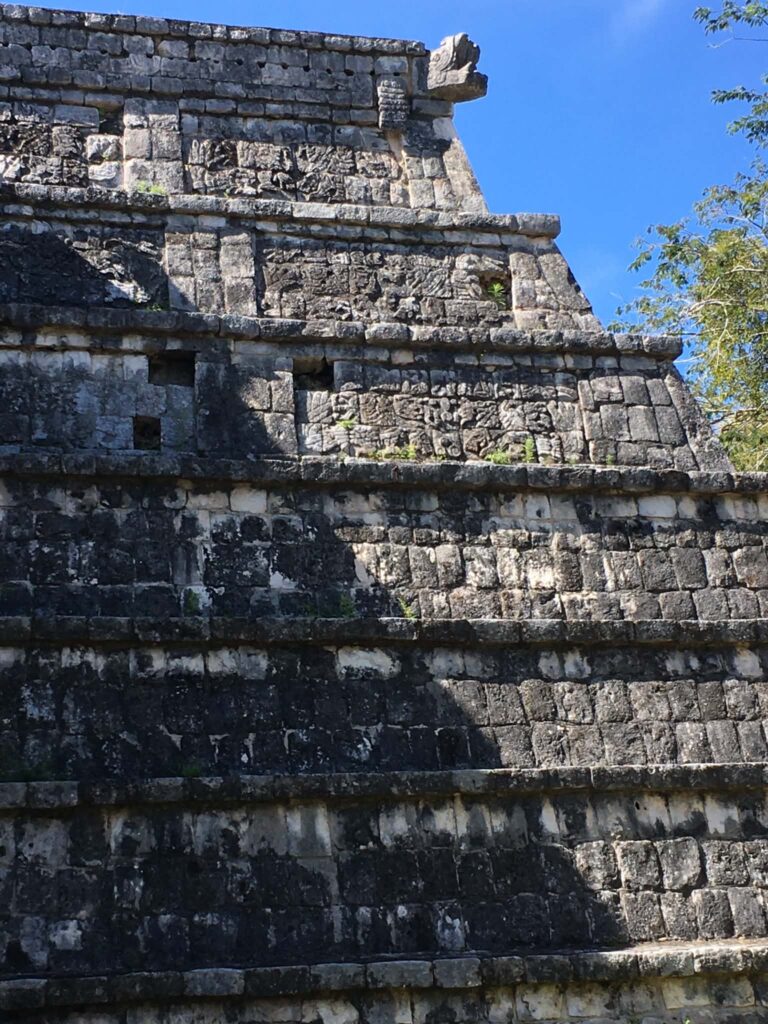
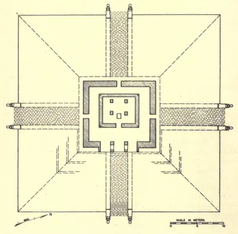
The Ossuary is a tiered stepped pyramid with stairways approaching its summit from four directions. At the summit stood an elaborate sanctuary surrounded by supernatural architectural imagery. Its most extraordinary feature, however, lies along its central vertical axis.
An opening within the summit sanctuary leads down into a masonry shaft descending through the pyramid and ultimately into the natural cavity beneath it. The monument was therefore not simply constructed over a burial place. Its architecture maintained a physical connection between the sanctuary at the top of the structure and the realm of the dead below.
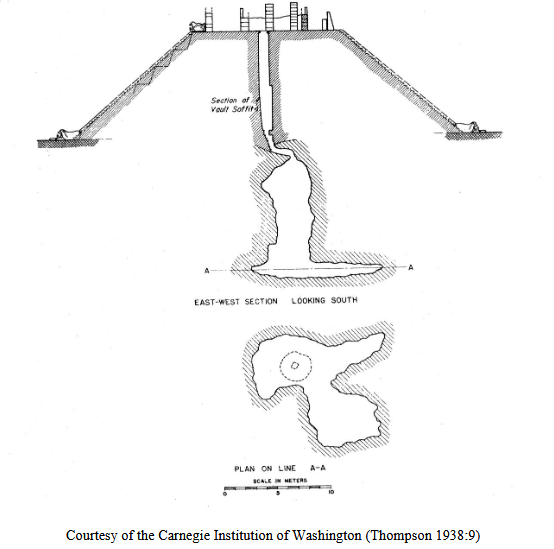
The shaft contained seven distinct graves before reaching the deeper cavity containing a much older along with newer accumulation of human remains, showing continued use for internment. The excavators described the transition into this lower area in explicitly underworld-like terms, referring to the opening as the “mouth of the underworld.”
The vertical organization is therefore fundamental to understanding the building:
sky and sunlight
↓
summit sanctuary
↓
seven graves in shaft
↓
mouth of the underworld cavern
↓
ancient and newer dead
The opening also had an astronomical function. The central axis permitted the zenith Sun to illuminate the shaft, creating a literal connection between sunlight above and the subterranean space below. The architecture therefore united the celestial and subterranean worlds through the occupied human space between them.
This same three-level organization occurs iconographically elsewhere at Chichén Itzá. At the South Temple of the Great Ball Court, human figures occupy the central register while a repeated celestial being appears above and the supernatural realm of Xibalba appears below.
At the Ossuary, that cosmological arrangement was not merely carved onto stone. It was constructed vertically into the building itself.
3. The Ancient Burial Place and the Seven Graves
The human remains beneath the Ossuary do not constitute a single burial event. The deepest cavity contained an accumulation of remains representing both an older and newer history of mortuary use. The seven graves constructed within the shaft belong to a distinct episode superimposed upon this ancient place of the dead. This distinction is essential.
Note: Early descriptions of the monument referred to six graves because Thompson mistakenly did the same at one point, but the burial sequence was subsequently corrected to the seven distinct graves that he actually wrote about in his records. The earlier count therefore survives in some discussions of the Ossuary even though seven grave locations were recognized.
Most of these graves appear to have been centered upon an individual burial, although the lowest grave contained remains from more than one person. The additional individuals may have been family members, servants or retainers, or others interred with the principal deceased. The surviving evidence does not establish their relationship to the primary individual buried here.
The grave goods nevertheless show that these were specially treated burials. Tripod vessels and copper bells recur within the graves, and the objects appear stylistically much older than the newest period of monumental construction at Chichén Itzá, indicating that the burial pit was used before and after these shaft graves were placed.
The lowest grave was substantially richer than the others, suggesting a difference in status among the people represented by the seven graves. In addition to multiple human remains, it contained a large jade fish and a specially treated casing stone bearing resin. Its position immediately precedes the opening into the deeper mortuary cavity—the “mouth of the underworld.”
The number of graves is significant in the narrative represented elsewhere in the monument. Xibalba is ruled principally by One Death and Seven Death, and the Ossuary’s sanctuary imagery depicts the Hunahpu generations interacting with Xibalban figures.
The seven graves are identified here with One Hunahpu through Seven Hunahpu, a group commemorated individually within the shaft grave. This does not mean that the graves contain only seven skeletons. One’s grave especially included relatives, attendants, or servants buried with that person. The relevant archaeological organization is the deliberate construction of seven grave units in the shaft, most of which apparently centered upon individual burials.
The older and newer remains below them in the cavern belong to a different point in history. The later monument transformed that ancient community burial place into something more: a shrine to a lost leader and his fellow ball players.
4. The Summit Sanctuary: Heaven, Humans, and the Dead
At the summit of the Ossuary stood a sanctuary organized into two sections, the inner realm and the outer realm. The inner realm contains four carved central pillars. In front of the pillars is a large hole where bodies were interred, as the inner sanctuary stood directly over the cavern of the dead.
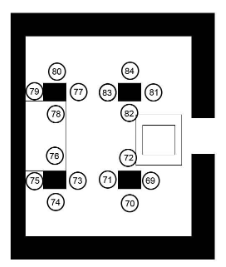
A separate three-dimensional simian figure was also recovered inside the space enclosed by the four central pillars.
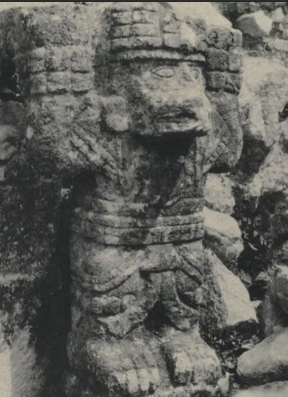
Its location is more important than simply identifying it as a monkey. The Hunahpu narrative includes Hun Batz and Hun Chouen, members of the preceding family generation who are transformed into monkeys and subsequently associated with artistic and performative activity.
The inner realm of the sanctuary also contained two representations of a winged solar god. It is believed that these figures occupied the room where the dead entered the shaft.
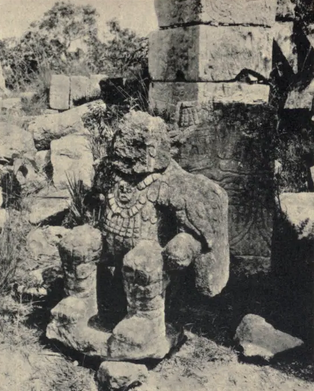
This being has been identified from the Great Ball Court. The upper portions of the South Temple pillars repeatedly contain the same celestial figure and solar imagery. Because individual examples are damaged, no single surviving South Temple image preserves every feature; however, the surviving portions collectively reproduce the same repeated solar/celestial composition. Archaeological reconstruction likewise recognizes the repetition of this upper supernatural figure.
It is believed that this good is the opposite to Chaac. When carved into architecture, his face mask is presented with a beak like nose.
The correspondence establishes a shared visual language between the two monuments:
Sun/Sky god above
↓
Humans
↓
Death god below
At the South Temple this order is represented vertically in relief. At the Ossuary it is both represented in imagery and physically built into the the building itself, with the nine level building and “underworld” below.
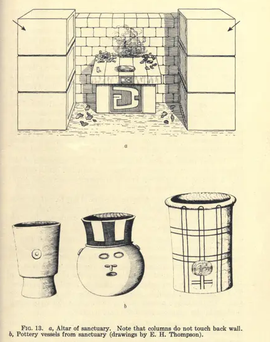
At the top, an altar occupied the outer realm of the primary structure. Early documentation shows a strikingly simple arrangement upon it: a detached human head/fruit simulation positioned between two cylindrical objects.
The head corresponds to the Hunahpu imagery identified elsewhere at Chichén Itzá. One of the accompanying cylindrical objects bears an annular device closely resembling the stone goal rings of the Great Ball Court. The other bears a circular emblem accompanied by paired lines.
5. Two Generations of Hunahpu Meet Xibalbans
In the inner realm of the structure, the four central pillars are not simply galleries of unrelated elite figures or gods. Their surviving scenes preserve encounters between the Hunahpu family and a recurring group of evil otherworldly figures called Xibalbans.
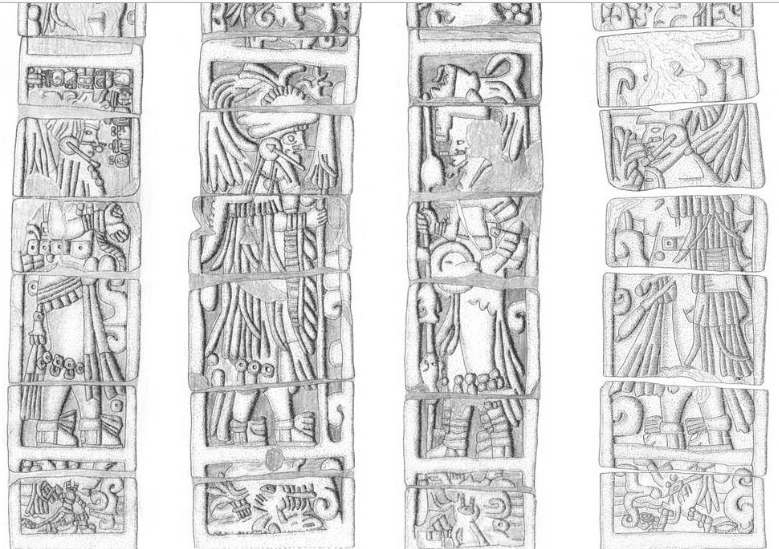
This series above depicts the first Hunahpu generation—One Hunahpu and Seven Hunahpu—encountering the Xibalbans. Their story begins with ballplaying in the human world, followed by a summons to Xibalba and a sequence of deliberate deceptions that ultimately results in their deaths. Note the glyph sequence in the top right corner of the far left figure. This is explained in the next section.
Subsequent pillar imagery depicts the later Hunahpu generation confronting the same Xibalban group.
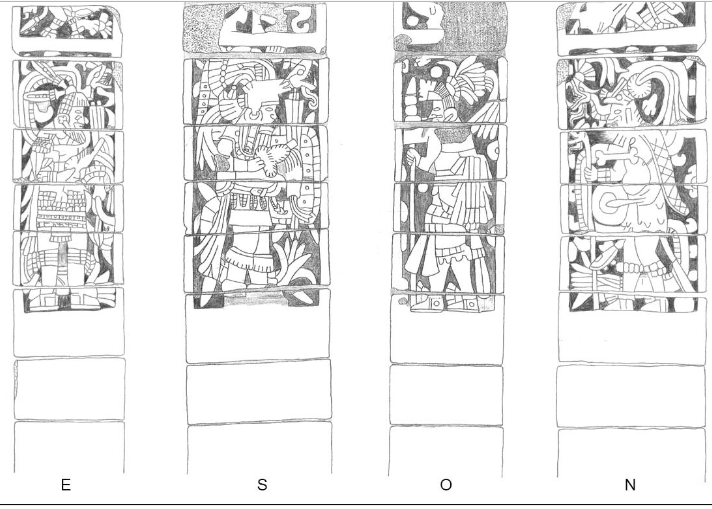
The inner realm containing the pillars preserves both generations of the conflict. The first generation descends, is deceived, fails the Dark House test, and dies. The later generation returns to Xibalba, encounters the same hostile powers, survives the six Houses, undergoes death and resurrection, and ultimately defeats the Lords who had killed the earlier generation. The four pillars therefore preserve an intergenerational narrative.
Their location directly above the seven graves is not incidental to that story. The human characters are carved in the sanctuary above the dead while the supernatural Xibalban figures confront them within the imagery.
6. The First Generation Inscription
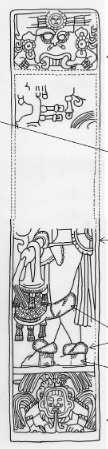
One of the most revealing elements of the Ossuary is a pictorial sequence associated with the first Hunahpu generation. Its organization is unusual and appears to use direction itself as narrative information. The published drawing labels the upper sequence alphabetically:
A – B – C – D – E – F
At glyph 1, however, the composition turns and continues downward:
1
↓
2
↓
3
↓
4
↓
5
↓
6
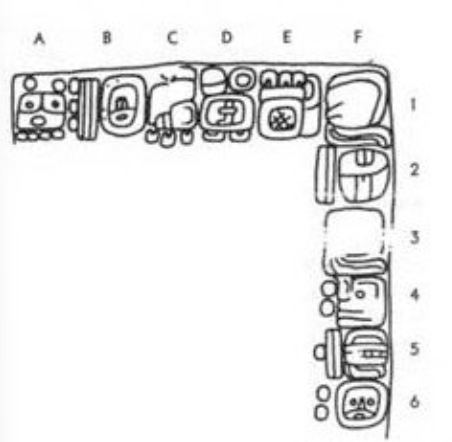
The horizontal sequence A–F belongs to the portion of the first-generation story up to the false-effigy encounter (crossing Trembling Canyon, Blood River, etc). Glyph A indicates the initial ball game that begins the encounter.
One important peculiarity should be preserved when analyzing the published drawing: the researchers assigned the single letter B to what visually appears to consist of two separate glyphic components. The combination was made in the previous documentation, not created for the present interpretation. The two glyphs located under B should therefore not automatically be assumed to encode only one narrative event.
The decisive change in the story occurs at the bend.
1 — The False Effigy
Glyph 1 resembles a simplified or artificial face. Its position corresponds to the first major deception after the brothers reach the Xibalban council.
One Hunahpu and Seven Hunahpu greet artificial figures believing them to be the Lords of Xibalba. The real lords ridicule them for failing to distinguish the effigies from living beings. The false person therefore marks the last event in the human realm and an appropriate beginning for the vertical Xibalban sequence.
2 — The Road and the Heated Stone
2 contains a distinctive vertical structure that reappears later at 5. This structure represents the road. The road is appropriate to this scene because the council encounter occurs immediately following their journey along the deceptive roads into Xibalba.
After entering Xibalba, the brothers are deceived again when they are invited to sit upon what appears to be an ordinary bench but is actually a heated stone. They are burned and mocked.
3 — The Missing Dark House
3 is too badly eroded to permit a confident visual reconstruction. Its narrative position however, is highly specific. Between the heated-stone deception and the brothers’ execution comes Dark House. One Hunahpu and Seven Hunahpu are given a torch and cigars and ordered to keep them burning throughout the night while returning them intact in the morning. They fail the test.
The destroyed 3 therefore occupies precisely the position of the Dark House episode.
4 — Death and the Two Brothers
4 is among the most important surviving images in the sequence. It depicts the distinctive long-nosed supernatural familiar from monumental architecture at Chichén Itzá. Immediately before him are two round shapes. These represent the two first-generation brothers at their deaths.
This is not an isolated appearance of Chaac. The same head with upturned nose occurs monumentally on the Ossuary itself and on other buildings at Chichén Itzá. Here, however, its placement within a sequential narrative supplies something architectural masks cannot: context.
The being appears in Xibalba at the deaths of One Hunahpu and Seven Hunahpu.
5 — The Roadside Head
5 repeats the same road element seen at 2. But now only one round head appears in association with the remaining imagery. After the brothers are killed, One Hunahpu is decapitated. His head is placed in a calabash tree beside the road. The formerly barren tree immediately becomes filled with fruit, and the severed head becomes indistinguishable from the calabashes surrounding it.
The repetition of the road at 2 and 5 is therefore significant. The same visual element occurs in two different scenes because the road occurs at both locations in the narrative.
5 also follows 4’s pair of round forms with a single round form, matching the narrative transition from two dead brothers to the one severed head placed in the tree.
6 — Completion of the First Generation
6 returns to two round circles, echoing the pair in 4, but now associates them with an enclosed or completion-like sign. The first-generation episode has ended.
The sequence therefore contains two sets of internal visual echoes:
2 ↔ 5: the road appears at two separate roadside episodes.
4 ↔ 6: the two brothers appear as a pair of circles together at their deaths and again at the closure of their narrative.
The inscription is consequently not a collection of unrelated symbols. Its images recur when the same people, places, or concepts recur within the story.
Even its direction contributes to its meaning. The pre-Xibalban portion proceeds horizontally on Earth; after the narrative reaches the Xibalban encounter, the inscription descends downward into the Underworld.
The reader follows One Hunahpu and Seven Hunahpu downward.
7. Chaac: Head Above, Serpent Below
The long-nosed supernatural depicted at 4 belongs to one of the most conspicuous architectural image traditions at Chichén Itzá. It has been previously identified as Chaac, the Maya supernatural associated with rain and storms.
At the Ossuary, enormous versions of this particular head formed the vertical corners of the summit architecture.
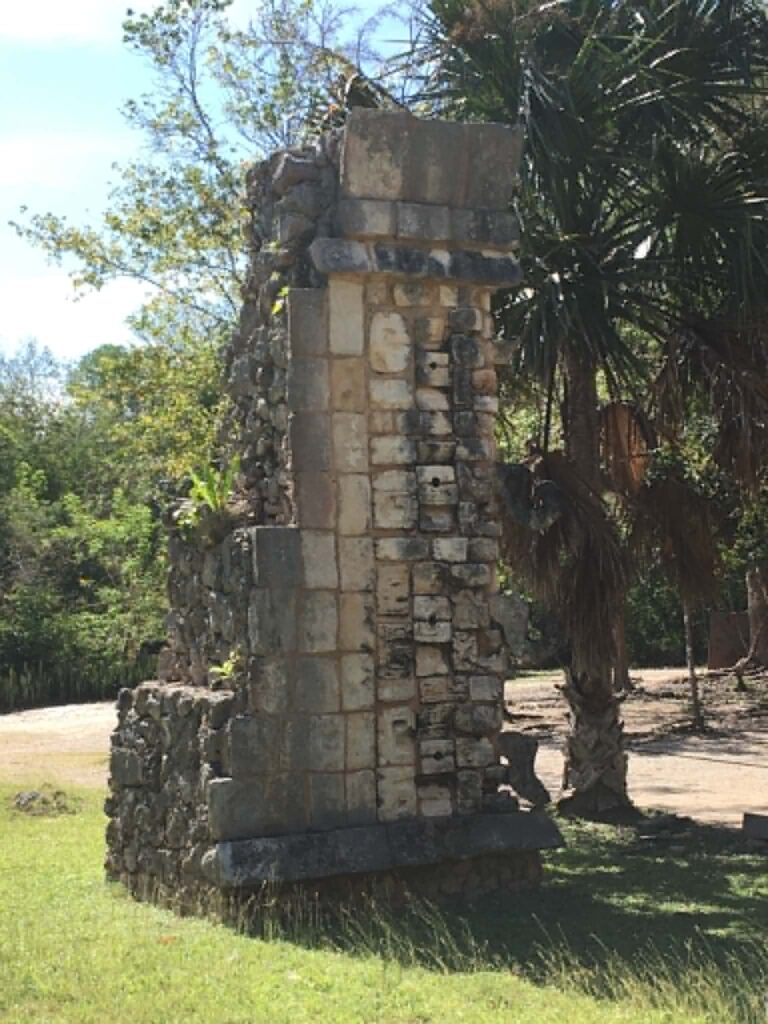
This is similar to what is seen at “The Church/La Iglesia”. (The building called The Church is believed by the author to have functioned as a mortuary or wake area for the recently deceased.) The same architectural being appears prominently at La Iglesia and on the corners of the lower portion of the Nunnery Annex, where stacked examples again occupy architectural corners.
A particularly unusual feature is concealed within the anatomy of the Chaac heads. They always have fully drilled ear holes, while the rest of the face is solid stone.
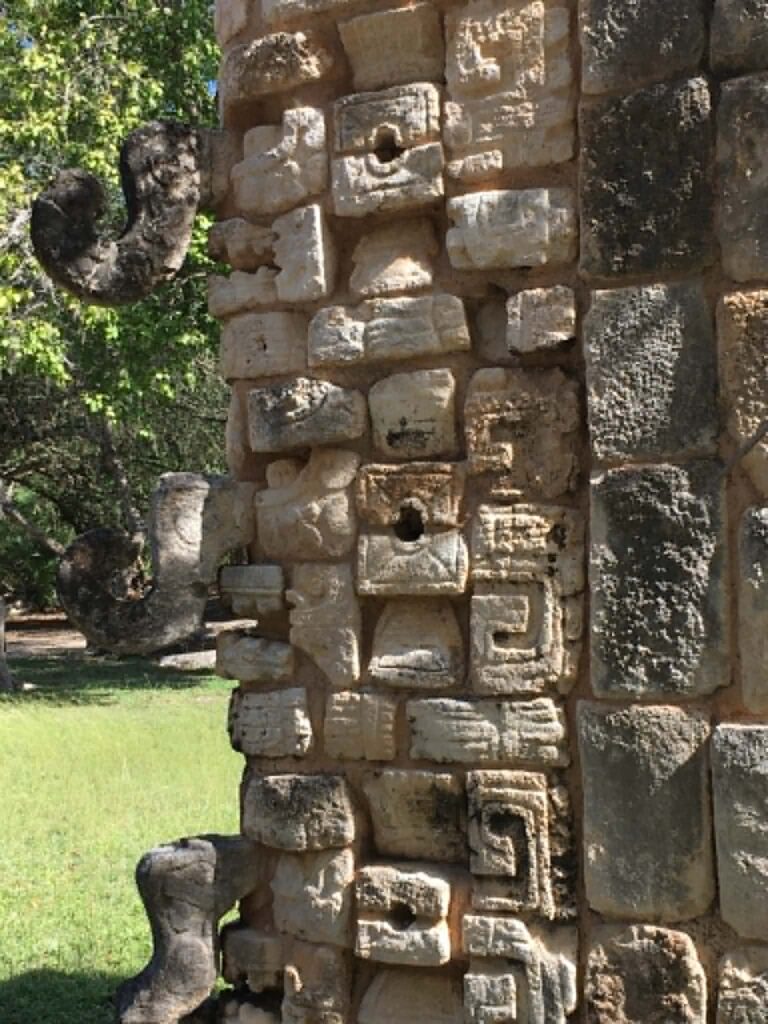
The circular openings are incorporated into the ears as though they were natural portions of the supernatural head, but these are not simply an eardrum representation. Their drilled form creates an acoustic masonry device; under appropriate wind conditions, air passing through the openings produces an eerie whistling sound. The supernatural architecture could therefore be both seen and heard in places associated with the dead.
This is especially significant at the Ossuary. Elevated on the summit corners, multiple acoustic openings would have been exposed to significant winds, while the monument itself stood directly above a shaft filled with the dead. The architecture effectively allowed the supernatural faces to make regular and sustained sounds without a visible human source.
Glyph 4 provides a confirmation context for this being. It appears within Xibalba immediately at the deaths of the two first-generation brothers. At the Great Ball Court, however, the underworld supernatural is represented differently, no longer just a face, the being is full bodied.
Rather than appearing merely as the enormous isolated head, the underworld register beneath the human figures of the South Temple shows the being in feathered-serpent form. The face and the feathered serpent are therefore different manifestations of the same otherworldly power: the monumental head dominates supernatural architecture, while the fuller serpent form occupies the underworld beneath the human narrative.
This also helps to explain the strangely upturned nose of the figure’s mask, which appears to mimic the striking form of a snake. The sky god is represented with a downturned nose, more indicative of a bird’s beak.
The conventional identification of the architectural heads with upturned as Chaac (the name itself) is likely correct. However, what requires reconsideration is the assumption that the image should be understood only through the modern shorthand of “rain god.” The Ossuary makes the death association of Chaac unusually explicit. Additionally, the four colors of roads in the story are known to be associated with Chaac.
The monumental heads surround a structure built over the dead. Its concealed acoustic openings allow the supernatural architecture to produce an eerie voice in the wind. Within the sanctuary’s narrative imagery, the same head appears at glyph 4, confronting the two first-generation brothers at the moment of their deaths. At the Great Ball Court, its fuller feathered-serpent manifestation occupies the underworld beneath the human actors.
The different representations are therefore complementary:
architectural mask = supernatural presence
acoustic ear hole whistles = supernatural voice
glyph 4 = encounter with Death in Xibalba
feathered-serpent form = the otherworld beneath the human realm
The imagery identifies not merely a deity but a realm and supernatural power encountered through death.
8. The Exterior Story
The Ossuary’s narrative is not confined to the summit sanctuary. Its exterior decoration begins telling the monument’s story before the visitor ever reaches the top. The lower panels prominently depict paired divine birds together with vegetation and offerings, including maize, cacao, fruits, seeds, and precious objects. The imagery is overwhelmingly concerned with life, food, abundance, and the products of the living earth.
These images are particularly meaningful on a monument whose interior descends into an ancient burial place. The exterior does not begin with death. It begins with life.
Above the lower living imagery, the decorative program changes. Serpents become increasingly prominent around the upper portion of the monument and its stairways. Their position places them between the imagery of the productive terrestrial world and the supernatural architecture of the summit.
The serpent therefore marks a transition. This same visual language appears at the Great Ball Court, where the feathered serpent occupies the realm beneath the human figures and identifies the supernatural world into which the Hunahpu’s descend. At the Ossuary, the architectural sequence can be read vertically:
animals, vegetation, food, and abundance
↓
the living earth
↓
serpents and transition
↓
supernatural summit sanctuary
↓
shaft through the monument
↓
seven dead
↓
mouth of the underworld
↓
community burial cavern
At the summit, god-like statues and the solar opening establish a connection to the sky as well. Sunlight can descend through the center of the monument toward the subterranean cavity, while the exterior celebrates the life produced upon the earth between those realms.
The Ossuary therefore presents death as one portion of a larger cycle. The dead lie below. Life flourishes above them. The supernatural world surrounds both, while the Sun descends from the sky through the monument’s central axis. The building itself becomes a model of death, earth, life, and regeneration.
This also helps explain why agricultural and funerary imagery coexist at the Ossuary. They are not competing interpretations of the building. They are different portions of the same cosmological system.
9. Historical Events Behind the Narrative
The Ossuary does more than reproduce mythology. Its burial evidence raises the possibility that the mythology preserved the memory of historical people and events. The seven graves are particularly important in this respect.
They were not the original reason human remains existed beneath the site. The deeper cavity had already served as a burial place for a very long period. The seven graves represent a later and deliberately organized intrusion into that ancient mortuary landscape. Those seven were treated differently from the anonymous accumulation below.
Most of the graves appear to have contained one individual. Some differed substantially in the quantity and quality of their grave goods, suggesting differences of status within the group. At least one contained additional individuals whose relationship to the deceased cannot now be established. They may have been relatives, servants, or retainers buried alongside the principal person. The important numerical feature is therefore seven principal grave units, not exactly seven surviving skeletons.
The number corresponds directly to the Hunahpu preserved in the narrative: One through Seven. That identification becomes considerably more significant when the burials are considered together with the sanctuary above them.
The four central pillars depict the Hunahpu generations meeting Xibalbans. The first generation inscription records the descent and death of One Hunahpu and Seven Hunahpu. Ball imagery occurs repeatedly within the Ossuary’s sculptural program. Beneath this narrative environment are the seven exceptional graves.
The graves and the story occupy the same physical space. This raises a larger historical possibility. The ballgame conflict remembered in the Hunahpu narrative likely preserves an account of actual rival people whose identities were subsequently transformed through generations of ritual retelling.
The evidence hints that seven players belonged to a full team, considering the significance to the repeated One-through-Seven naming structure. Likewise, One Death and Seven Death may preserve the endpoints of an opposing seven-member team.
If an actual conflict involving ballplayers ended violently, the dead could have become the historical foundation for the Xibalban retelling and recreation. The Ossuary would then represent an extraordinary transformation of history.
An existing ancient burial site became the enshrined resting place of seven specially commemorated dead. Narrative scenes showed them confronting Xibalban inhabitants, and the shaft descended through the seven graves into the ancient dead beneath them. They were likely actual historical people who became supernatural characters through tragedy. The event involving the conflict became mythology in the modern day.
What survives beyond the story is the engravings and monuments that preserve a memory of Chichén Itzá’s own past. Seven ballplayers, seven opponents associated with death, two generations of conflict, execution, decapitation, and eventual defeat of the Xibalban group.
10. Conclusion: One Narrative Across Two Monuments
The Ossuary and Great Ball Court should not be read as unrelated monuments decorated with a common collection of Maya religious motifs. They preserve overlapping portions of the same narrative system.
At the Ossuary, both generations of the Hunahpu family encounter the inhabitants of Xibalba. The first generation’s story is preserved clearly in the pictorial sequence that begins horizontally and then turns downward into the Xibalban episode.
The outer realm of sanctuary contained an altar with a detached One Hunahpu head and ballgame imagery. The glyphs in the burial sanctuary reinforce the meaning. The simian and solar god figures were recovered within the four central pillars of the inner chamber. Beneath the chamber are seven distinct graves, and below that is the mouth of the underworld.
The monument’s exterior tells the same cosmology on another scale. The Great Ball Court continues the story in physical space. The monuments overlap deliberately. The Ossuary preserves the people, deaths, supernatural realm, and earlier generation.
The Great Ball Court preserves the later confrontation and ceremonial reenactment. Together, they explain one another. What survives at Chichén Itzá is therefore more than buildings decorated with mythology. The architecture is part of the history in more ways than one.
References
Thompson, Edward H., and J. Eric S. Thompson. 1938. The High Priest’s Grave, Chichen Itza, Yucatan, Mexico. Field Museum of Natural History, Anthropological Series, Vol. 27, No. 1. Chicago: Field Museum Press. This is your source for the original shaft excavation, graves, altar, pottery, monkey figure, sculpture photographs, jade and other burial material.
Digitized Thompson report
Schmidt, Peter J. 2011. “Los oficiantes de la pirámide del Osario en Chichen Itza, Yucatán.” In XXIV Simposio de Investigaciones Arqueológicas en Guatemala, 2010, edited by B. Arroyo, L. Paiz, A. Linares, and A. Arroyave, pp. 1163–1179. Museo Nacional de Arqueología y Etnología, Guatemala. This is the paper supplying the four-pillar documentation, plans, Figure 6 inscription, exterior program, bird panels, summit imagery, and Schmidt’s archaeological reconstruction.
Schmidt Ossuary paper
González de la Mata, María Rocío, Francisco Pérez Ruiz, and José Osorio León. 2011. “Análisis comparativo de los pauahtunes de Chichén Itzá.” In XXIV Simposio de Investigaciones Arqueológicas en Guatemala, 2010, edited by B. Arroyo, L. Paiz, A. Linares, and A. Arroyave, pp. 1180–1192. Museo Nacional de Arqueología y Etnología, Guatemala. This is useful for the Ossuary supernatural figures, La Iglesia, Chaac/Pauahtun context, animals, cosmological levels, and comparisons across Chichén.
Pauahtun comparison paper
González de la Mata, María Rocío, Francisco Pérez Ruiz, Peter J. Schmidt, and José Osorio León. 2018. “Antiguas exploraciones con nuevas propuestas: el Templo Sur del Gran Juego de Pelota (2D1) de Chichén Itzá.” In XXXI Simposio de Investigaciones Arqueológicas en Guatemala, 2017. This is the South Temple paper you’ve used for the six pilasters, Hunahpu figure, damaged/reconstructed reliefs, and repeated celestial/underworld registers. The paper explicitly describes the pilaster imagery as organized into underworld, terrestrial, and upper-sky levels.
South Temple PDF
Christenson, Allen J., trans. and comm. 2007. Popol Vuh: Sacred Book of the Quiché Maya People. Electronic version of the 2003 University of Oklahoma Press publication. Mesoweb. This is the clean source for the narrative sequence: One Hunahpu and Seven Hunahpu, the effigies, roads, heated bench, Dark House, deaths, calabash tree, later Hero Twins, and Xibalba.
Christenson Popol Vuh