
Deciphering the Phaistos Disc – By Donna Evans
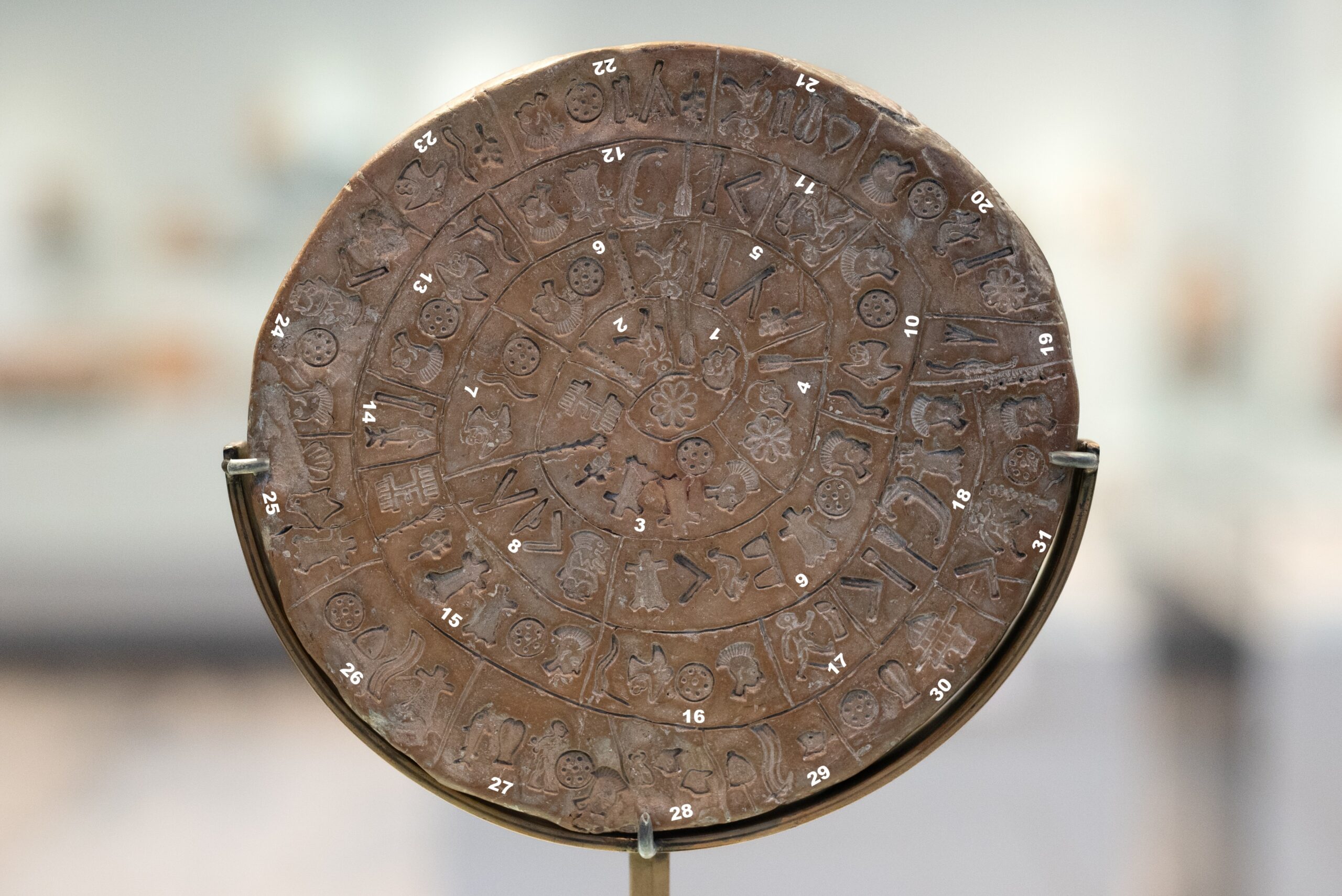
Translation
Side 2 continues Triptolemus’ journey into a society increasingly concerned about sea-Carians and military production. The flower designated settlement depends heavily on grain, while intensive hunting, fishing, and tree-cutting supports the sea-Carians and their shipbuilding. The resulting pressure harms water systems, reptiles, seed-dispersing birds, fish, bees, and other wildlife.
Triptolemus repeatedly gathers knowledge and people to force reductions in shipbuilding and to shift provisioning toward grain and domesticated fowl. Periods of rest allow ecological recovery, but harmful practices recur, requiring repeated intervention by Triptolemus and Demeter. Knowledge spreads through Triptolemus’ journeys, while olive cultivation and other practices spread among the sea-Carians. The final blocks return to water-management and ecological truth, culminating in Triptolemus entering direct conflict with the sea-Carians. The Disc ends with him still walking, leaving the larger narrative unresolved and suggesting continuation on another object or disc.
Block-by-Block Decipherment
| block | Glyph sequence | Decipherment/narrative meaning |
| 1 | Flower • person with food in cheek • grain | Citizens of the settlement identified by a flower primarily ate grain. |
| 2 | Walking Triptolemus • club | Triptolemus journeyed to the flower settlement to warn its people about the clubs. |
| 3 | Plow-like tool • weapon tree • olive tree • two inverted REST figures • water • Carian | Intensive clearing for the weapon and olive trees was occurring in very large volume due the sea-Carians, likely including military/ship production. |
| 4 | Flower • person with food in cheek • grain | Exact repeat of block 1. The flower settlement continues to grow and consume its staple grain. |
| 5 | Olive tree • forked fruit-harvesting stick/branch • collection | The olive tree and its fruit were being actively harvested/collected. |
| 6 | Walking Triptolemus • club • water • Carian | Triptolemus resumes his journey to warn people about the clubs and encounters the sea-Carians. |
| 7 | Water • upward-facing snake/reptile • upward-facing seed-dispersing bird | Water conditions, reptiles, and seed-dispersing birds were suffering. The seed markers identify the birds as important seed dispersers. Vertical animal facing upwards indicates distress. |
| 8 | Fruit-harvesting stick • basket • leads to • Demeter | Branch cutting for the fruit-harvesting sticks and basketry contributed to the problem and led to a call to Demeter for help. |
| 9 | REST • leads to • standing bird • planting • REST • water • Carian | The rest request led to birdkeeping and a pause in agriculture by the sea-Carians. The planting glyph here helps explain the earlier tooth-burying episode on Side 1. |
| 10 | Speared/dead snake • dead seed-dispersing bird • water • Carian | The sea-Carians were still causing the deaths of snakes/reptiles and seed-dispersing birds. *Note that Inverted animals on their backs and speared snakes both indicate death. |
| 11 | Walking Triptolemus • inverted hoofed leg | While traveling, Triptolemus observes that ungulates (sheep/deer/etc.) are in distress. |
| 12 | Leads to • collection • grain • boat • REST • Carian | The people Triptolemus gathered pressure the land-based Carians to switch to grain foods and pause shipbuilding. |
| 13 | Speared/dead snake • upright seed-dispersing bird • water • Carian | The sea-Carians still killed snakes/reptiles, but the seed-dispersing birds had recovered. |
| 14 | Collection • fish | Fish were still collected/harvested. |
| 15 | Plow-like tool • weapon tree • olive tree • two REST figures • water • Carian | The clearing of land for the weapon and olive trees is put into a significant double rest period by the sea-Carians. |
| 16 | Speared/dead snake • upright seed-dispersing bird • water • Carian | The sea-Carians continue killing snakes/reptiles, while the seed-dispersing birds remain healthy. |
| 17 | Walking Triptolemus • inverted hoofed leg | While traveling, Triptolemus again observes that ungulates (sheep/deer/etc.) are in distress. |
| 18 | Leads to • collection • grain • boat • REST • Carian | Exact repeat of block 12: the gathered people again pressure the land-based Carians to switch to grain and pause shipbuilding. |
| 19 | Intertwined snakes • upward-facing bird foot | Snakes/reptiles reproduced. Wild bird populations are again in distress. |
| 20 | Flower • collection • standing bird • water • Carian | The flower settlement collected domesticated fowl for the sea-Carians, hoping to relieve the pressure on wild birds. |
| 21 | Seed • truth/connection • oil press boards • walking Triptolemus | Seeds and the truth about oil presses is recognized (oil production requires even more seeds and wood). Triptolemus sets out again to let the people know. |
| 22 | Olive tree • fruit-harvesting stick • oil press boards • water • Carian | Olive cultivation, fruit-harvesting, and oil pressing continued among the sea-Carians. |
| 23 | Olive tree • upward-facing snake • upward-facing seed-dispersing bird | The sea-Carians’ olive-tree practices were harming reptiles and seed-dispersing birds. |
| 24 | Pierced shell [inferred from next block] • leads to • Demeter • water • Carian | The killing/harvesting of shell-bearing animals for pierced shell material led Demeter to confront the sea-Carians. |
| 25 | Leaders/hunters • pierced shell • REST | Leaders/hunters using animals for jewelry needed to rest. – The shell material may have been used for jewelry, decorative clothing, plate armor, or another manufactured purpose. |
| 26 | Water • seed • river • REST | River water used for irrigation/farming needed to be rested or reduced. |
| 27 | Upward-facing fish • truth/connection • walking Triptolemus • water • Carian | Triptolemus journeys to the sea-Carians with the truth about distressed fish/aquatic populations. |
| 28 | Upward-facing bee • downward-angled double lynx head | Bees are in distress, and lynx populations are being doubly impacted. |
| 29 | Original/modified seed • river • dead lynx | Riverbank agriculture involving the original/self-sowing seed was still resulting in lynx deaths. |
| 30 | Water • truth/connection • house | The truth about irrigation/water use and settlements is realized. |
| 31 | Leads to • walking Triptolemus • club • water • Carian | This leads Triptolemus into direct conflict/war with the sea-Carians. The Disc ends with Triptolemus still in journey form, suggesting that the larger narrative continues beyond the surviving Disc. |
Conclusion
The Phaistos Disc appears to preserve a society already struggling with the consequences of its own success. Agriculture, settlement growth, timber cutting, fishing, hunting, tool production, and shipbuilding all expand together, placing increasing pressure on the same landscape and animal populations. The Carians and sea-Carians were not solely responsible for this damage: the agricultural communities themselves cleared land, displaced lynxes, consumed fish, expanded settlements, and increased their demand for timber and olives.
The conflict appears to emerge because both populations required increasingly scarce resources. Triptolemus repeatedly attempts to impose limits, while the Carians—who are not initially identified with water on Side 1—become progressively associated with maritime activity. Land-based Carians are referenced again on Side 2 in regards to grain collection. The surviving Disc ultimately ends with Triptolemus entering direct conflict with these water-based Carians, suggesting that the war itself is documented on another disc.
Remarkably, later Greek historians preserve what appears to be the endpoint of just such a development. Herodotus records a Cretan tradition in which the Carians had once inhabited the Aegean islands, were associated with Minos, and supplied men for his ships. He also specifically credits the Carians with introducing crests on helmets, providing an unusually strong historical parallel for the Disc’s repeatedly crested people.
Thucydides preserves the more hostile phase of the tradition. Minos possessed an early navy, gained control of much of the Aegean, and expelled the Carians from the Cyclades. He further reports that, when ancient graves on Delos were later opened, more than half were recognized as Carian from their weapons and burial customs. These accounts suggest that the later Greeks still remembered both phases of the relationship: Carians as an old Aegean maritime population connected with Cretan sea power and land-based Carians eventually displaced through conflict with Minos.
The Phaistos Disc likely preserves something the later historians no longer knew: how that conflict developed. The Carians appear first without the water association that later defines them. As agricultural populations expand into land and resources, ordinary people begin arming themselves with tree-trunk clubs in response to Carian pressure. Timber use and shipbuilding increase, and the Carians become increasingly maritime.
From their perspective, expanding agricultural communities were consuming land and repeatedly demanding limits on hunting, fishing, timber use, and shipbuilding. From the agricultural communities’ perspective, the Carians hunting, weapons, and maritime expansion intensified ecological and security problems they were already struggling to control.